
For a long time, we have lived with the illusion that there are impenetrable computer systems. The reality, however, is much more nuanced: in the realm of security, it all boils down to how much effort, time, and resources it takes to force a lock. Just as it is not the same to open the door of a house as the vault of a bank, the digital world has various levels of resistance. There are more or less resistant barriers and unexpected shortcuts that can bypass brute-force methods. The ultimate goal of cybersecurity is not to achieve perfection but to make it impractical for an attacker to break through. From this perspective, the risk never disappears; it can only be managed.
With this pragmatic approach, Apple has been layering defenses to make every step more arduous for potential attackers, thereby limiting their maneuvering space. According to the Cupertino company, the most sophisticated exploitation chains observed against iOS stem from mercenary spyware that takes advantage of memory vulnerabilities . Although Apple does not explicitly mention it, they are likely alluding to threats such as Pegasus from the NSO Group. Their answer to these threats is an innovative piece in the security framework: a reinforcement that integrates hardware and system-level technologies aimed at monitoring memory integrity and cutting off unauthorized access before it can escalate into a full-blown attack.
Memory Integrity Enforcement on iPhone 17 and iPhone Air
Apple has unveiled Memory Integrity Enforcement (MIE) as part of the new iPhone 17, iPhone 17 Pro, Pro Max, and iPhone Air. MIE represents an integrated memory defense that works directly within both the hardware and operating system. This milestone is the result of five years of collaborative effort among their teams specializing in Chips and Software Engineering , aimed at drastically increasing the cost and complexity associated with attacks based on memory corruption. MIE is designed to operate continuously and transparently, covering critical areas like the kernel and over 70 processes in user space, while maintaining efficiency in energy consumption and device performance.
The nucleus of MIE employs multiple layers that work in a synchronized manner to enhance security. The memory allocation systems are arranged by data type, akin to organizing items in specific drawers. This structure complicates the likelihood that a program error would allow one data type to overwrite another. If an anomaly does occur, the system is designed to detect it before it becomes an attack. This is where the Enhanced Memory Tagging Extension (EMTE) comes into play, a hardware technology that adds another layer of scrutiny to memory management.
EMTE assigns a “secret label” to each memory block. Whenever an app or the system seeks to access that block, it must present the correct label; if the labels do not match, hardware blocks attempts , and the system can terminate the process. This ongoing and synchronized verification process allows for the detection and prevention of classic attacks such as buffer overflows or use-after-free vulnerabilities. Such vulnerabilities are common techniques used to compromise device security. While the allocators protect large memory blocks, EMTE provides precision control over the smallest segments, an area where software alone may fall short.
This permanent and synchronized check allows the detection and prevention of classic attacks like buffer overflows.
The initiative responds to a landscape of threats where iOS faces the highest levels of risk, often linked to complex, targeted attacks typically associated with state actors. These sophisticated chains often share the same vulnerabilities: interchangeable memory weaknesses that have plagued the industry. MIE aims to disrupt this progression at the earliest stages, when attackers still have limited options and rely on a series of fragile steps to seize control.
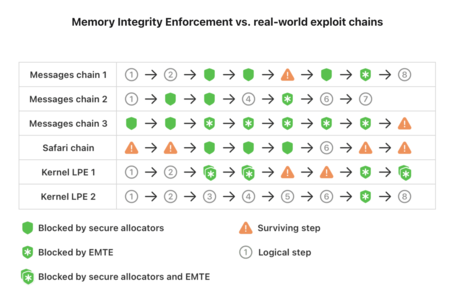
<span>Apple graph showing real exploitation chains and the points where it blocks them.</span>The scope of this protection encompasses not just the kernel but also extends to essential system processes that are often primary targets for exploitation. Moreover, Apple has made it easier for developers to test and integrate these defenses through the Enhanced Security option in Xcode, which encompasses EMTE capabilities on compatible hardware. This is particularly significant for applications where users might be direct targets, such as messaging or social network platforms, which frequently find themselves at the start of exploitation chains.

</div>To facilitate the labeling and synchronized checking without noticeable impact on performance, Apple redesigned the A19 and A19 Pro processors, reallocating CPU resources, CPU speed, and memory for label storage. The company meticulously modeled how and where to deploy EMTE, ensuring that the hardware fulfills the necessary demands for these checks. Meanwhile, the software leverages the typed assignments to elevate protection against memory corruption, while the hardware handles precise verification. As stated earlier, this design philosophy aims to sustain user experience without compromising expected performance and battery life.
This project underwent extensive evaluations with Apple’s offensive research team from 2020 to 2025. Initial efforts involved conceptual exercises, which were followed by practical attack simulations and finally tested on hardware prototypes. This prolonged collaboration allowed Apple to identify and neutralize complete exploitation strategies before they were widely adopted. According to Apple, even when they attempted to reconstruct known actual chains, they were unable to restore them reliably against MIE, as too many steps had been neutralized at their core.
<img alt="IA browsers have a problem: that anyone who knows how to write will be able to hack them." width="375" height="142" src="https://i.blogs.es/c6d32b/comet/375_142.jpeg"/>Nonetheless, Apple is keen to remind us that absolute security remains an unattainable goal. There will be exceedingly rare cases where some overflows might persist within the same allocation. For prior generations that do not support EMTE, Apple is committed to continuing to roll out software-based enhancements and secure memory allocators, aiming to extend some of these benefits to earlier devices without jeopardizing system stability.
Ultimately, MIE does not eliminate risk , but it effectively redefines the rules of engagement by significantly increasing the complexity and cost of memory corruption techniques. For those who invest in an iPhone 17 or an iPhone Air, this translates into constant and, according to Apple, invisible protection for end users.
Images | Xataka with Gemini 2.5
In Xataka | Or pay, or we will use your work to train AI: the threat of hackers to an artist’s website.
In Xataka | How to change all our passwords according to three cybersecurity experts.