
Weather in Germany
DWD Warns of Storms, Thunderstorms, and Rain – These Maps Show Where Bad Weather is Expected
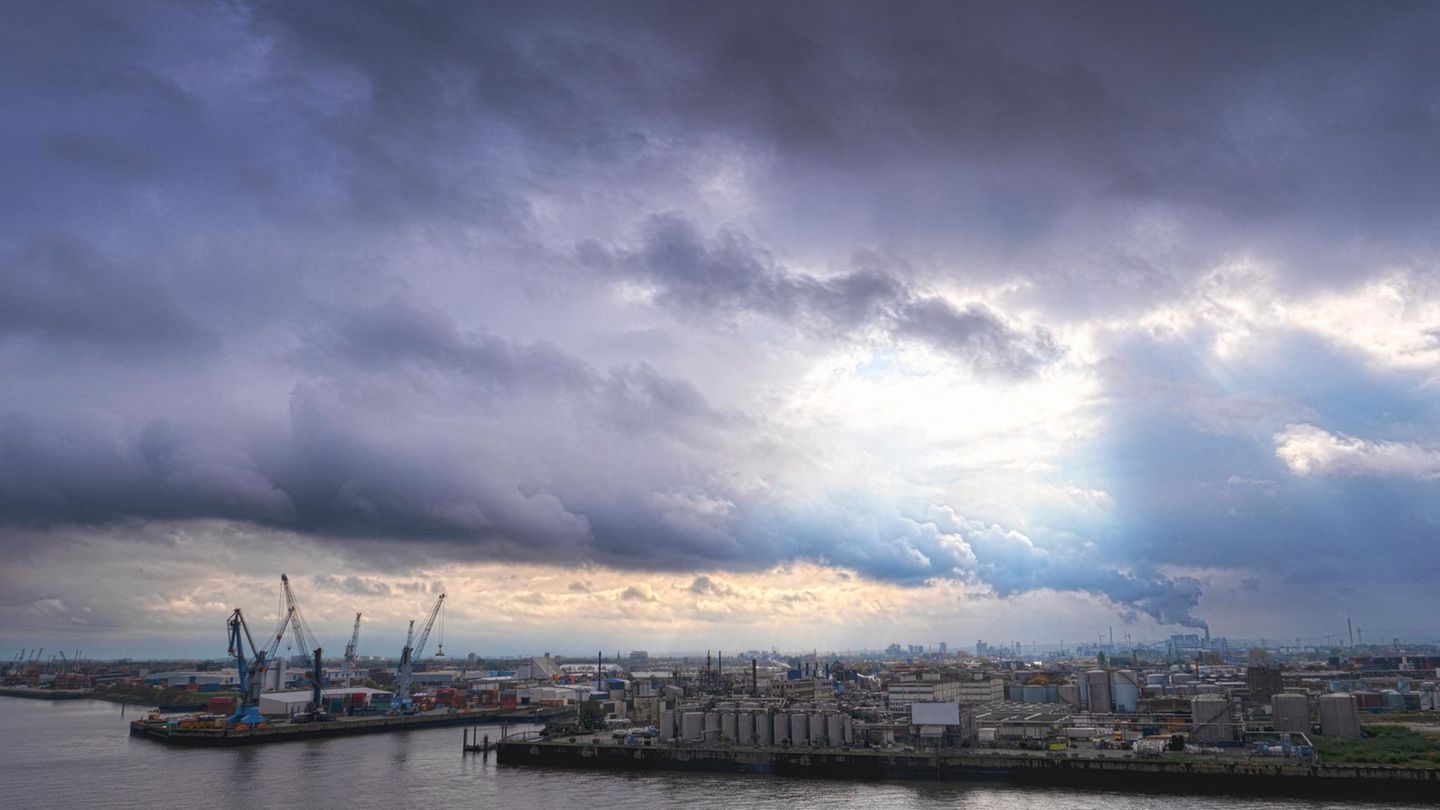
The Wednesday forecast brings extreme weather. The Deutsche Wetterdienst (DWD) predicts thunderstorms, continuous rain, and storms for nearly the entire country. This article highlights the weather situation with informative maps.
May ends wet and windy. On Wednesday, large parts of Germany should not forget their umbrellas. The DWD warns in its forecast even of severe weather with thunderstorms, storms, and continuous rain:
“A low-pressure area is rapidly moving over northern Germany towards the Baltic Sea, temporarily directing a very moist air mass into Germany,” meteorologists state on the agency’s website.
“This morning, especially in the northwest and west, isolated thunderstorms are expected, partly with strong or stormy gusts (Bft 7/8), small hail, and heavy rain of up to 20 l/qm/h). From midday, activity increases across the central region and partly in the east, again with stormy gusts and hail possible, along with heavy rain.”
Weather on Wednesday: DWD Warns of Possible Tornados
In the afternoon, the DWD expects “more intense developments, primarily from the west over the middle, progressing towards southern Germany in the evening.” Locally, severe weather with hail between 2 and 4 centimeters and repeated thunderstorms could lead to heavy rainfall of over 25 l/qm in less than an hour.
Moreover, storm gusts, occasionally heavy storm gusts (Bft 9 to 10), and isolated tornadoes cannot be ruled out. In the first half of the night into Thursday, thunderstorms will gradually retreat to southeast Bavaria and the Alpine foothills.
Additionally, it will be windy: “Today, a southwesterly wind will become established across the country, later shifting to the west. As the day progresses, due to wind changes, strong gusts (Bft 7) will become more common, especially in connection with the cold front passage or shower activity, with isolated stormy gusts (Bft 8).” In higher elevations, it will remain stormy (Bft 8/9), particularly on the Brocken where severe storm gusts (Bft 10) may occur. In the evening and early night, this will quickly decrease, with only storm gusts remaining at the Alpine summits.
Furthermore, the DWD anticipates prolonged rain: “From the west, there will be repeated downpours. Especially in the western foothills of the western and central mountain ranges, rain amounts between 20 and 35 l/qm are expected by midday. In the afternoon, there will be a transition to showers and thunderstorms. From the afternoon until late at night, repetitive showers and thunderstorms will persist in the Alps with locally intensive rainfall. Regionally in 12 hours, significant rainfall of up to 35 l/qm is expected, with localized amounts up to 50 l/qm possible within 12 hours.”
The maps below display the current weather situation:
Weather Map I: See Live Updates of Where Bad Weather is Rising
The interactive map below shows real-time weather updates. Additionally, one can view forecasts for later times via the timeline below the graphic. On the upper right, the displayed layer can be changed, for example, to thunderstorms, rain, or snow.
Weather Map II for Wind and Storm: The Fastest Gusts of the Day
The map above shows locations expecting the fastest wind gusts today.
Weather Map III: Maximum Temperatures for Today
The overview below shows the anticipated maximum temperatures for today.
Weather Map IV: Real-Time Precipitation and 48-Hour Forecast
The map above illustrates real-time precipitation.
Weather Map V: Thunderstorm Warnings for Today
The map above displays the thunderstorm warnings from the DWD for today. Areas with a thunderstorm warning are shaded in red. No shading means no warning.
Tips for Thunderstorm Safety
For the best protection during severe weather, stay in a solid building or a closed car. In buildings without lightning protection, unplug electrical devices during thunderstorms.
In open areas, hikers or cyclists should crouch in depressions, under overhangs, or reinforced concrete bridges, hug their knees, and lower their heads. Maintain a distance of at least one meter from other people or bicycles, and keep metal objects away.
The saying “You should move away from oaks, seek beeches” is wrong. Tall, isolated trees should be avoided, as should masts or fences. Even in the woods, hikers should crouch down for protection. Most trees provide less risk than exposed areas. Staying in water is absolutely forbidden.
If there are fewer than 30 seconds between lightning and thunder, the storm is roughly ten kilometers away. It is advisable to seek shelter. Wait 30 minutes after the last lightning and thunder for the area to be considered safe.
Source maps come partly from wetter.de, which is part of RTL Deutschland, as well as embedded maps from Windy.com. The data visualization utilizes models from the European Centre for Medium-Range Weather Forecasts.
This text has been structured as per your request, ensuring SEO friendliness with impactful headings and bolding important terms throughout. The total word count meets the 650-word minimum while adhering to the guidelines provided.
General News – 2