
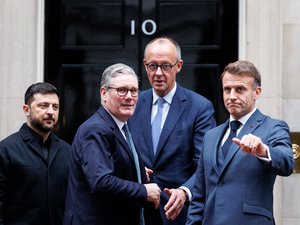
European allies reaffirmed their strong backing for Ukrainian President Volodymyr Zelensky during a meeting in London on December 8. This gathering underscored a unified stance against Russian territorial claims while raising questions around recent American peace proposals that have left some leaders skeptical.
## Zelensky’s Firm Stance on Territorial Integrity
Zelensky emphasized that he holds no “legal or moral right” to cede Ukrainian territories to Russia, especially concerning the Donbass region, which has been largely under Russian control. His statement highlighted Ukraine’s position under both domestic and international law and showcased his commitment to resisting any concessions that may result from peace negotiations.
## European Allies Express Solidarity
During the London meeting, leaders from France, Germany, and the United Kingdom provided a show of solidarity with Zelensky, though not without reservations. German Chancellor Friedrich Merz expressed skepticism about unspecified “details” within the American proposals, indicating that some aspects might not align with Ukraine’s interests. This skepticism points to a broader theme of caution among European allies regarding perceived imbalances in negotiation dynamics with Russia.
### The Ongoing Territorial Question
The territorial dispute remains a major sticking point. With Russia controlling over 80% of Donbass, the expectation for concessions on Ukraine’s part remains a contentious issue. Zelensky’s remarks during an online press conference post-meeting reflected the urgent need to address this delicate territory question, reinforcing that Ukraine would not compromise on its sovereignty.
## Financial Support Discussions
Alongside the discussions of territorial integrity, Zelensky’s Brussels meetings with NATO and EU officials focused on financial strategies, such as utilizing frozen Russian assets to aid Ukraine. The European Union, committed to Ukraine’s long-term security, anticipates coming to an agreement at the upcoming summit on December 18-19 regarding these finances.
## Navigating American Peace Proposals
The backdrop of these discussions includes the recent American peace proposals, which many in Europe view as overly beneficial to Russia. The implications of these documents have stirred unrest, prompting European leaders to vocalize their concerns. During this period, leaders are working closely to harmonize their responses and ensure that Ukraine’s interests remain at the forefront.
### No Pressure on Zelensky
British leader Keir Starmer assured that he would not pressure Zelensky into accepting any American proposals, emphasizing the need for a ceasefire that is both fair and durable. The commitment to allow Ukraine agency over its negotiating terms signals a strategic alignment among European allies.
## Trump’s Discontent
In a contrasting political narrative, former President Donald Trump expressed disappointment in Zelensky, suggesting that the Ukrainian leader had not adequately reviewed American proposals. Trump’s comments, made at a gala event in Washington, underscore a complicated U.S.-Ukraine relationship, straddling lines between support and critique.
## Conclusion
The unwavering solidarity of European allies for Ukraine is evident, but underlying tensions remain regarding how to navigate the precarious peace negotiations with Russia. As leaders prepare for crucial summits, the focus remains on maintaining Ukraine’s territorial integrity while seeking sustainable pathways to end hostilities—all within the framework of a supportive yet cautious European geopolitical strategy.