
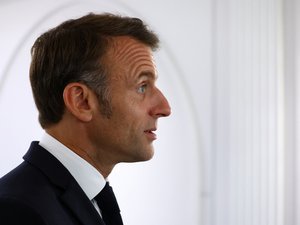
France has decided to mobilize three Rafale fighter jets to bolster airspace monitoring in Poland and Eastern Europe following Russian drone incursions . This was announced by President Emmanuel Macron on Thursday, marking a significant response to rising tensions in the region. Warsaw has also imposed air restrictions that are scheduled to remain in place until December 9, aimed at safeguarding its airspace amidst security concerns.
In his statement, Macron reinforced France’s commitment to protect Polish airspace and vowed that they would not “give in to the growing intimidation of Russia.” He noted that he had been in contact with Polish Prime Minister Donald Tusk , NATO Secretary General Jens Stoltenberg , and British Prime Minister Keir Starmer regarding the situation.
“Following the incursions of Russian drones in Poland, I decided to mobilize three Rafale fighters to contribute to the protection of Polish airspace and the eastern flank of Europe with our NATO allies,” Macron tweeted.
Understanding the Airspace Restrictions
In response to the recent drone breaches, the Polish government has imposed a complete ban on drone flights , while also introducing air traffic restrictions along its borders with Belarus and Ukraine. These measures were taken after several alleged Russian drones violated Polish airspace. In a notable first since the onset of the war in Ukraine, Poland successfully intercepted these drones with the help of its NATO allies.
The newly instituted airspace restrictions have taken effect from 10:00 PM GMT on Wednesday , and remain in force until December 9 . According to a press release from the Polish Air Navigation Services (PANSA) , these restrictions do not affect passenger air transport, ensuring that commercial aviation remains operational. However, specifics about the air traffic regulations have been outlined, aiming to maintain national security while minimizing disruptions to civilian travel.
“At the request of the operational command of the armed forces, restrictions on air traffic will be introduced into the eastern part of Poland in the form of the regulated area EP R129 ,” PANSA stated. General aviation can still function during the day, provided aircraft are equipped with a radio and transponder. However, these aircraft will not be allowed to operate at night.
Specific Restrictions in Place
The new regulations stipulate that flights are permitted up to a maximum altitude of about 3 kilometers (approximately 10,000 feet ) above ground level. This altitude range is well below the operational ceiling for most commercial flights, which typically occur at higher elevations.
According to PANSA, “These restrictions do not apply to passenger aviation, as the area of restriction is defined to FL095 , which is between the ground and approximately 3 km above sea level.” The regulated area extends between 26 to 46 kilometers into Polish territory, dependent on specific locations.
Notably, flights in this restricted airspace are prohibited from sunrise to sunset , with exceptions made for piloted aircraft that adhere to established flight plans and maintain appropriate communication with air authorities. Military flights and certain specified flights will also be allowed under this framework.
Concerns in the Aviation Sector
The Russian Defense Ministry has publicly acknowledged conducting a significant drone attack targeting military facilities in Ukraine , asserting that they did not intend to breach Polish airspace. However, the drone incident has sparked intense reactions across NATO countries, amplifying security concerns regarding civil air travel in Europe.
Polish Foreign Minister Radoslaw Sikorski announced that the UN Security Council would convene an emergency meeting at Poland’s request to discuss the airspace violations. As these events unfold, the resurgence of security worries has also negatively impacted civil air transport. Major airports in Warsaw, including Chopin and Modlin , along with facilities in Rzeszow and Lublin , were temporarily shut down on Wednesday as a precaution but later resumed normal operations.
In light of the ongoing tension, Michael O’Leary , the director general of Ryanair , has cautioned that the ongoing conflict between Russia and Ukraine is likely to be a recurring issue for all European airlines in the coming years. Such comments highlight the long-term implications of geopolitical unrest on global air travel, underlining the need for heightened vigilance and security measures.
Amid these tensions in Eastern Europe, it is evident that regional security is a paramount concern for NATO members and that ongoing vigilance is necessary to ensure safety in air travel. Both military and civil aviation sectors must adapt to the evolving landscape characterized by unpredictable drone incursions and geopolitical strife.