
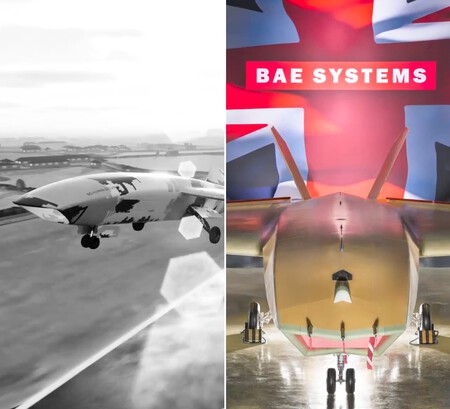
For decades, every major leap in British military aviation has had a pilot at its center. From the iconic Harrier to the formidable Tornado and the sleek Typhoon, the tradition of piloted aircraft continues strongly. However, a significant shift is emerging with the introduction of systems that drastically change this paradigm. The United Kingdom plans to incorporate an aircraft that doesn’t need a pilot onboard.
The Brontanax: A New Era in Combat Aviation
The new development is aptly named Brontanax. At the recent Farnborough Air Show, attendees witnessed a model showcasing this revolutionary concept from BAE Systems. Although this was not the testing prototype, the operational unit is reportedly assembled and undergoing preparations for ground testing at Warton. Importantly, this isn’t merely a concept on paper; a physical prototype is ready for evaluation.
Design and Functionality
To grasp the true nature of Brontanax, one must look beyond typical drone imagery. This aircraft, comparable in size to the British Hawk, belongs to the Collaborative Combat Aircraft family—designed for combat missions as part of a larger operational strategy. BAE Systems envisions it serving alongside piloted aircraft like the Typhoon, enhancing battlefield effectiveness without the risks associated with operating additional manned fighters.
Key Operational Capabilities
The Brontanax is engineered for two primary functions: electronic warfare and precision attacks targeting both ground and air assets. The overarching objective is to distribute responsibilities among several aircraft, which the defense industry terms “combat mass.” This strategy allows the Royal Air Force to send unmanned units into higher-risk zones, thus preserving the safety of pilots.
Government Investment and Future Plans
In a timely move, the British Government has committed £300 million (approximately €351 million) to the Storm Fighter program, aimed at fostering autonomous combat capabilities and integrating them with existing aerial operations. The plans are ambitious—with a demonstrator expected to take flight by 2027 and operational capacity planned before the decade’s end. However, these goals remain developmental and do not guarantee service entry.
Lessons from Past Attempts
This isn’t the first attempt at integrating unmanned companions into UK fighter formations. The Project Mosquito aimed for similar objectives but was discontinued in 2022. Unlike its predecessor, BAE Systems claims to be fully financing this current initiative through private investment. The real challenge lies not just in producing a prototype but in proving its capabilities in practical flight tests.
Competitive Landscape
The UK is entering a competitive arena where other nations have already begun flight testing their unmanned systems. Australia, for instance, has recorded over a hundred flights with Boeing’s MQ-28 Ghost Bat, while the United States has awarded contracts for the General Atomics FQ-42 and the Anduril FQ-44. While the UK’s Brontanax is yet to demonstrate any air capability, it promises a prototype that could change the tide in aerial warfare.
Images | BAE Systems