
The WiFi Woes of Spanish Trains: A Comparative Analysis
For many commuters and travelers across Europe, WiFi connectivity in trains is a significant factor influencing their journey experience. Unfortunately, when it comes to Spain , the situation is far from satisfactory. According to a recent report from Ookla , the Spanish railway system ranks lower than many of its European counterparts, with a troubling median download speed of just 1.45 Mbps . This puts Spain on the list of countries with the worst train WiFi, especially when compared to Sweden , which boasts an impressive 64.58 Mbps .
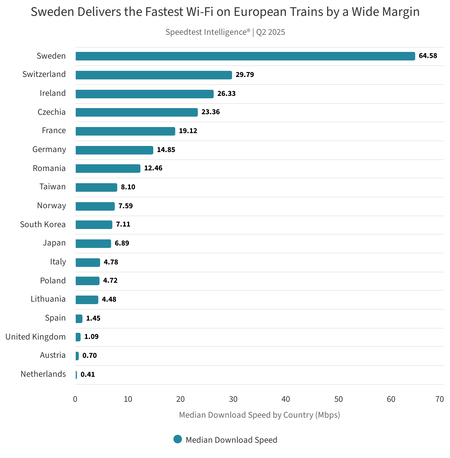
<span>Image: Ookla - Average unloading speed on European trains.</span>A Multi-Layered Problem Facilitating Disconnection
The challenges facing rail WiFi in Spain are multi-faceted. One of the primary issues stems from a deficiency in the backhaul connection. The backhaul is integral in how trains connect to public mobile networks and, therefore, how well they are able to provide internet service. Most countries, including Spain, rely on “incidental” mobile coverage ; that is, the antennas are primarily designed for stationary population centers rather than the rapidly moving trains. This leads to frequent dead zones , signal drops, and insufficient bandwidth, leaving many passengers frustrated during their travels.
Outdated Technology: A Barrier to Connectivity
Within the train carriages themselves, outdated technology further hampers connectivity efforts. A significant portion of connections still operates on WiFi 4 , a standard established in 2009. Additionally, 38% of connections utilize the 2.4 GHz band , which is more susceptible to interference. This mixture of old technology means that even if external connections improve, internal WiFi quality will remain low.
<img alt="Mobile Internet is bad" width="375" height="142" src="https://i.blogs.es/2fc797/sin-datos/375_142.jpeg"/>Innovative Solutions: Learning from Other Countries
Several countries have successfully improved their train WiFi systems, offering valuable lessons for Spain. For instance, Sweden recently made significant advancements in its train connectivity. Until early 2024, Swedish trains offered a mere 2 Mbps . However, post-reforms by the PTS regulator , including the allocation of public funds for infrastructure and the establishment of network obligations, saw this speed multiply by more than 30 times within a year.
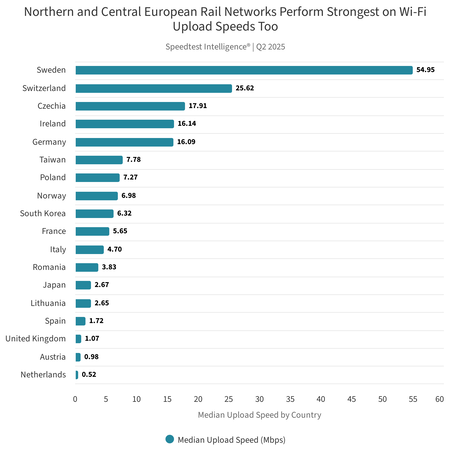
<span>Image: Ookla - Average upload speed on European trains.</span>Switzerland and France: Contrasting Approaches
Switzerland employs a unique model centered around a service known as “FreeSurf.” This system allows passengers with a Swiss SIM card to use mobile data without tapping into their usual rates while traveling. Meanwhile, France has invested in a dedicated rail network that features base stations positioned every 2-3 kilometers along major routes. Such robust infrastructure has elevated France’s ranking in train connectivity, placing them well above Spain.
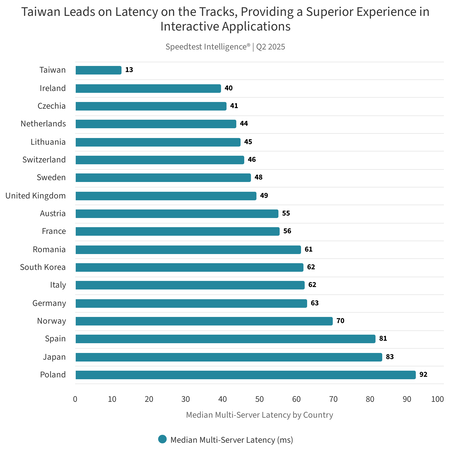
<span>Image: Ookla - Median latency of European countries compared to Taiwan.</span>Structural Challenges: WiFi or Mobile Data?
Spanish trains are not only hindered by coverage but also by the structural design of modern trains. Many rail cars are designed to block signals, functioning almost like Faraday cages due to the Low-E glass used in windows. Some countries, like Germany , have already begun addressing this by investing significantly in making their train windows permeable to signals. Meanwhile, Belgium opted to invest funds differently by enhancing mobile coverage instead of rolling out an onboard WiFi plan.
Global Perspectives: Mobile Data Takes Precedence
In much of Asia , nations like Japan, South Korea, and Taiwan prioritize dedicated mobile data coverage over traditional WiFi on trains. They invest considerably in creating robust mobile networks that can effectively serve trains traveling at high speeds. In Taiwan, for instance, speeds exceed those of Spain and even include the presence of WiFi 6 technology on some rail lines.
With satellite internet solutions emerging in various regions, there is renewed hope for train connectivity. Many rail operators, including SNCF and Trenitalia , are exploring the use of platforms like Starlink in low-coverage areas. Although these approaches are in test phases, they reflect the ongoing evolution of train connectivity strategies across the globe.