
The Shift in the US-China Chip War
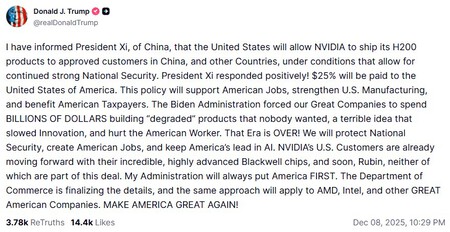
The chip war between China and the US has shifted from a blockade to a commercial transaction. Recently, Donald Trump announced that he would allow Nvidia to export its high-performance H200 chips to China. This authorization comes with an unprecedented condition: the US government will receive a 25% commission on these sales. This “reverse tariff” effectively transforms China containment into a revenue stream, moving away from a strategy of complete suffocation and providing Nvidia a crucial opportunity in its key market.
End of Free Blocking
This decision stems directly from a recent meeting between Trump and Jensen Huang, CEO of Nvidia. The White House’s rationale has evolved, asserting that the measure is now enforceable under strict national security conditions. This new stance has laid the groundwork for applying a similar model to other tech titans like Intel and AMD.
Nvidia’s H200 Chip: A Strategic Choice
Choosing to allow the H200 chip is a calculated move. This chip is significantly more powerful than the H20 model, which China began to boycott, but it still falls short of the next-generation Blackwell architecture, which remains banned. According to advisors like David Sacks, the US aims to keep China reliant on its technology. If denied access to advancements, China may be forced to pursue alternatives on its own.
The Reality of Black Markets
The total blockade strategy has been largely ineffective, as seen in recent investigations indicating that Chinese companies resorted to loopholes through Indonesia to acquire banned chips. Additionally, a burgeoning second-hand market has emerged as a key avenue for China to obtain chips such as the H100 and A100 while flying under the radar.
China’s Response and Implications
The implications of this recent development reach into the heart of China’s response. Although Trump claims that Xi Jinping reacted “positively,” the current reality on the ground suggests otherwise. For months, China has been actively prohibiting its companies from purchasing Nvidia chips to foster the growth of its domestic industry. The Cyberspace Administration of China (CAC) even examined the H20 chips, seeking potential backdoors, which fostered an atmosphere of mistrust that earlier agreements have failed to alleviate.
Opportunities amidst Geopolitical Tensions
For Jensen Huang, the pact represents a golden opportunity to maintain access to a market that constitutes 13% of Nvidia’s revenue. However, Chinese clients now find themselves navigating the complexities of American geopolitical maneuvers, which could reshape their access to vital technology.
In summary, as the chip war evolves, the balance of power in technology and trade continues to shift. The US’s strategic pivot towards monetizing chip sales to China underscores the complex interplay between national security and economic interests.