
The Warning from CENTCOM
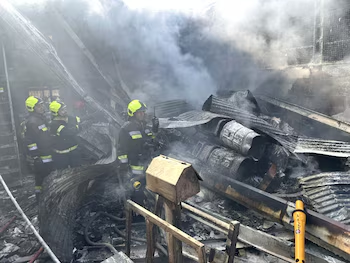
The United States Army Central Command (CENTCOM) recently issued a stark warning to civilians in Iran, highlighting that urban areas, particularly in the provinces of Dezful, Isfahan, and Shiraz, are being used as bases for military operations, including drone and ballistic missile launch platforms. This situation jeopardizes the safety of innocent civilians, as locations utilized for military activities could lose their protections under international humanitarian law.
Implications for Civilians
According to CENTCOM, this “dangerous decision puts the lives of all civilians in Iran at risk.” With military targets embedded within civilian areas, these sites could now be classified as legitimate military objectives. This development raises alarming ethical concerns about civilian safety and the responsibilities of warring parties.
The Escalation of Conflict
The warning came just eight days into a new phase of conflict that began on February 28. During this period, Iran has launched hundreds of ballistic missiles and thousands of one-time-use attack drones. Despite CENTCOM’s reports of a slowdown in launches due to U.S. military operations, the Iranian military maintains its stance, declaring a commitment to escalate missile use in the coming hours.
Human Cost of the Conflict
As of the latest reports, Iran’s Health Ministry stated that over 1,200 people have died and more than 10,000 have been injured since the conflict erupted. Tragically, the casualties include 198 women, primarily students killed during an attack on a primary school in Minab, further intensifying the humanitarian crisis.
International Response and Future Implications
The conflict’s repercussions are wide-reaching, affecting not just Iran but its neighbors. Iranian missiles and drones have struck civilian infrastructure in countries like Bahrain, the UAE, and Kuwait, leading to urgent discussions among Arab League foreign ministers.
Furthermore, the Swiss Council of Ministers has declared initial U.S. and Israeli actions as violations of international law, while also condemning Tehran’s retaliatory strikes. As tensions rise, France has dispatched military assets to the Mediterranean in response to these developments.
Potential for Displacement
Migration experts express grave concerns that if the conflict exacerbates, Iran—home to nearly 92 million people—could witness mass displacement rivaling the Syrian refugee crisis. The continuing war dynamics and Iran’s ability to sustain the conflict will play crucial roles in determining the humanitarian landscape moving forward.