
The Football Powerhouse: Uruguay
When it comes to the question, Which country produces the most elite footballers?, many immediately think of Brazil with its rich footballing history and five World Cups. However, the statistics reveal a lesser-known reality: Uruguay stands tall as a footballing giant on a per capita basis. Though it has a population of only about 3.5 million, comparable to cities like Madrid or Berlin, Uruguay boasts an impressive footballing pedigree that is hard to overlook. With two World Cups, two Olympic medals, and 15 Copa América titles, this small nation has achieved remarkable success on the global stage.
The Numbers Behind the Talent
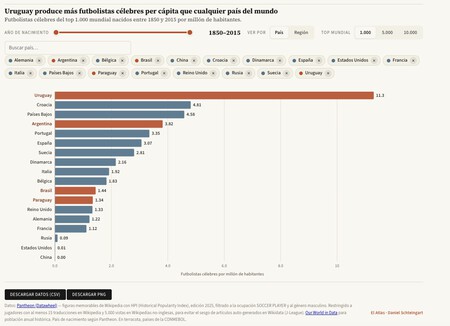
A recent interactive project, The Atlas, analyzes the number of elite male footballers produced by different countries relative to their populations. The results are striking. Uruguay emerges as the clear leader, generating 11.3 elite football figures per million inhabitants. In comparison, Croatia, the second-ranked country, produces only 4.81 elite players per million, followed closely by the Netherlands and Argentina with 4.58 and 3.82, respectively.
How Does Uruguay Do It?
The reasons behind Uruguay’s extraordinary success in football development are multifaceted. According to ESPN Deportes, the country has 28 professional clubs dedicated to nurturing young talent. When compared to Argentina and Brazil, which would need 336 and 1,624 clubs respectively to match Uruguay’s proportion, it becomes evident why Uruguay excels in this arena. This concentrated effort allows scouts and coaches to discover and cultivate potential stars that might otherwise be overlooked in larger nations.
The Impact of Cultural Factors
Another critical factor is the focus on football as the predominant sport among youths in Uruguay. In contrast to Europe and the United States, where talent is often distributed among various sports, Uruguayan children primarily aspire to become footballers. This singular dedication allows for a significant concentration of talent, which further fuels the country’s production of elite players. However, there is a note of caution regarding the future: as football becomes increasingly technical and globalized, wealthier nations may begin to dominate the sport.
Limitations of Data
While the graphs and statistics paint a glowing picture for Uruguay, it is important to keep in mind that the metrics are based on the historical fame of players, as determined by their Wikipedia presence. This does not necessarily translate to an objective measure of football quality, which can favor contemporary players over legendary veterans with less digital footprint.
In summary, despite its size, Uruguay’s commitment to nurturing football talent has made it a formidable force in producing elite footballers. As the data showcases, it is not just about the number of players but the quality and passion woven into the very fabric of Uruguayan football.