
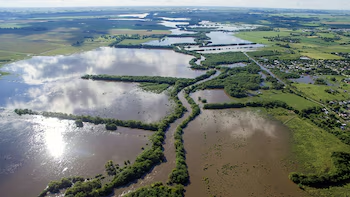
## Urgent Demand for Completion by 2030
The Confederation of Rural Associations of Buenos Aires and La Pampa (CARBAP) has made a bold declaration regarding the Río Salado Master Plan, labeling its completion by 2030 as “urgent and non-negotiable.” For the past nine months, these stakeholders have been enduring unprecedented flooding in the central region of Buenos Aires, compelling them to speak up.
### The Catalyst: Climate Events
Recent climatic events have not only exacerbated the flooding issue but have also highlighted the longstanding concerns of local producers. CARBAP emphasizes the dire need for accelerated governmental action, stating that the current weather patterns lack any signs of abating, directly impacting the livelihoods of both producers and residents.
### Responsibility at All Levels
“Irrespective of their position, all authority figures bear responsibility in this situation,” stresses Ignacio Kovarsky, chair of CARBAP. This collective responsibility has ignited a call for immediate action across municipal, provincial, and national levels.
#### Current State of Affairs
The Salado River basin spans approximately 17 million hectares, yet over 2 million hectares are currently flooded, affecting nearly 3.8 million hectares in total. This staggering statistic has raised alarms about agricultural production and infrastructure.
### The Economic Impact
The affected areas are not just measured by visible water but also by land that remains inaccessible for agricultural activities. Poor soil conditions and impassable roads hinder any progress, effectively sidelining vast amounts of arable land and rural families from their livelihood.
#### Demands from CARBAP
CARBAP insists on a unified commitment from all three levels of government to take accountability for this predicament. They have set forth a clear and compelling objective: the full realization of the Río Salado Master Plan by 2030.
### A Call for Solidarity
“The ongoing flooding represents a moral, productive, and social obligation,” CARBAP declares. This sentiment resonates deeply considering the impact on a multitude of families and residents in Buenos Aires.
#### Technological Feasibility
The organization reassures stakeholders that the demands made are grounded in practicality. “We are not asking for impossible feats,” they assert, noting that the required infrastructure—canals, bridges, and hydraulic systems—are well within reach. Argentina boasts the necessary expertise, machinery, and technicians.
### The Core Issues of Funding and Political Will
CARBAP has raised concerns regarding the commonly heard excuse of financial constraints. “In this basin, money exists,” they counter, explaining that it is generated each year by local producers and collected by the state.
### Conclusion: Action Must Not be Delayed
“Floods do not wait,” concludes CARBAP, reinforcing the urgency of their message. The intertwining issues of rural stability, education, health, and security hinge on a collaborative effort to expedite the Río Salado Master Plan’s completion by 2030. Immediate action is not just necessary; it is non-negotiable.