

In Spain, public employment has become an increasingly attractive option for millions of individuals. The relentless cycle of job insecurity, combined with challenges faced by both young professionals and those over 55 seeking employment in the private sector, has prompted many to consider preparation for public employment exams, known as oposiciones, as a viable career path.
According to the National Institute of Statistics, with approximately 2,789,200 individuals unemployed, it is no surprise that more than half of the active workforce, around 12 million people, has considered taking these exams to secure a stable job with a reliable salary within the public sector.
The Public Employment Offer for 2025 has already been announced by the Government, detailing a total of 36,588 available positions. These vacancies include posts within state security forces, the military, and various government roles. Of these, 27,697 are brand new positions, while 8,891 are internal promotions. Notably, a large proportion—around 70%—is aimed at the General State Administration, and 10% of these positions (equivalent to 2,610 jobs) are specifically reserved for individuals with disabilities, thereby widening access to opportunities in the public sector.
Unemployment as a catalyst for opposing has been a significant trend. Currently, over 2.7 million people in Spain face unemployment, with many struggling to re-enter the private job market due to age-related barriers. A report by OpositaTest indicates that of the unemployed individuals aged between 18 and 55, approximately 48% are either preparing for an opposition or plan to begin soon. This figure jumps to 68% when accounting for those who have previously taken such exams.
The recruitment landscape for officials reveals that variations in unemployment rates across different autonomous communities correspond inversely with the percentage of the active population either preparing for or already engaged in the opposition process. For instance, in Extremadura, where the unemployment rate is at 16.60%, 48% of the active population is involved in opposition preparation. Comparatively, Murcia, with a 12.83% unemployment rate, shows 43% of its labor force similarly motivated. On the contrary, regions like Catalonia (where just 19% intend to pursue oppositions) and Madrid (at 21%, alongside Valencia and the Balearic Islands) display lower interest levels.
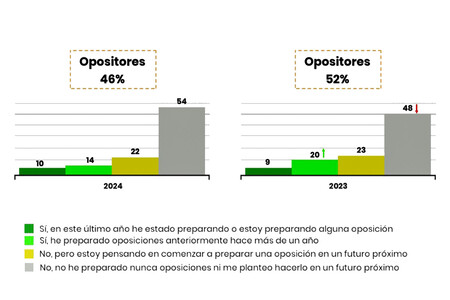
Current statistics reveal that approximately 6,779,344 people are actively preparing for oppositions or have taken them recently, accounting for nearly 52% of the active population. This analysis shows a remarkable trend: 9% of individuals opposing today began their preparations merely a year ago, indicating that 67% had never attempted this route prior to their current efforts. Such numbers highlight a significant shift towards the public sector, drawing in individuals who had not previously considered careers in government.
Demanding roles in public administration, auxiliary bodies, as well as health and education positions are highly sought after among current candidates. While aspirations for administrative roles remain consistent among active opposition candidates, those intending to participate in future exams express significantly higher interest in postal positions, indicating new trends within public employment aspirations.
Ultimately, the transition towards favoring public employment reflects a broader societal shift, driven by economic factors and job security considerations. As the landscape continues to evolve, the future potential of public employment opportunities appears promising, especially for those valiantly navigating the challenging waters of job market instability.