
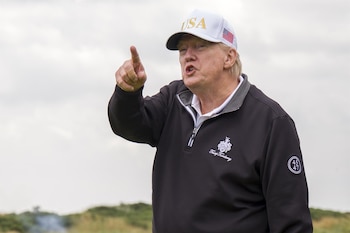
The President of the United States , Donald Trump, has recently rejected the proposal articulated by British Prime Minister Keir Starmer regarding the potential recognition of a Palestinian state. During his statements on board Air Force One , Trump emphasized that such a move could end up being a “reward” for the Islamic resistance movement (Hamas) .
Context of the Proposal
Starmer’s announcement comes at a critical time, when he has voiced concerns about the humanitarian situation in Gaza . He stated that the UK would recognize Palestine during the United Nations General Assembly in September if Israel does not fulfill three essential conditions. These conditions include: putting an end to the “terrible” humanitarian situation in Gaza, agreeing to a ceasefire, and committing to a long-term sustainable peace that adheres to the two-state solution .
Trump’s Response
In response, Trump made it clear that he finds the notion of recognizing Palestine problematic. “If they do that, they will really be rewarding Hamas,” said the Republican leader. His statements highlight a significant rift between the positions held by the governments of the UK and the US regarding the Israeli-Palestinian conflict. Trump notably pointed out that this specific issue was “never discussed” during his recent meeting with Starmer in Scotland . During that meeting, he also interacted with Ursula von der Leyen , President of the European Commission .
Growing Support for Palestinian Recognition
Starmer is not alone in his stance. The Prime Minister of France , Emmanuel Macron, has already announced that France plans to recognize Palestine as a state during the forthcoming UN assembly. This move is consistent with France’s historical commitment to seeking a “fair and lasting peace” in the Middle East . Alongside France, several Western countries, including Spain , have also begun to recognize Palestine, reflecting a shifting tide in the international stance on this issue. Following Macron’s announcement, over 200 conservative and Labour MPs in the UK urged Starmer to follow in Paris’s footsteps.
Implications for International Relations
The potential recognition of Palestinian statehood by more Western nations could have significant implications for international relations. The divisions between the US and the UK concerning the Israeli-Palestinian conflict might not only influence bilateral relations but could also shift the dynamics in the European Union and the broader international community. Countries that have traditionally sided with Israel may find themselves re-evaluating their positions in light of changing sentiments among their allies.
The Humanitarian Situation in Gaza
At the heart of these political maneuvers lies the dreadful humanitarian situation in Gaza. With escalating tensions and ongoing military confrontations, the residents of Gaza face dire conditions. Reports indicate widespread food insecurity , a lack of access to clean drinking water, and insufficient medical care. According to various human rights organizations , the ongoing blockade has compounded the humanitarian crisis, making it nearly impossible for many families to meet their basic needs.
Conclusion on Future Prospects
As global leaders grapple with this complex and sensitive issue, the international community must weigh the implications of recognizing Palestine against the backdrop of ongoing violence and instability in the region. While some countries are moving towards recognition, the US’s firm stance against it reflects deep-seated geopolitical interests. How this plays out in the coming months will undoubtedly influence not only the peace process but also the political landscape in the Middle East for generations to come.