
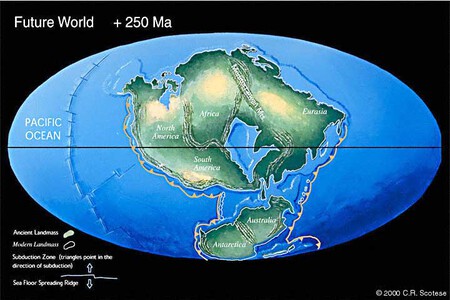
The Rise of Pangea Ultima
About 200 million years ago, the last supercontinent, Pangea, began to shatter, leading to the slow drift of continents to their present positions. However, geological theories suggest that these landmasses will eventually converge again, potentially forming a new supercontinent—referred to as Pangea Ultima—over the next 250 million years.
The Science Behind Continental Drift
Plate tectonics, the scientific paradigm that explains the movement of the Earth’s lithosphere, drives continental drift. Each plate is in constant motion, which raises questions about how landmasses might rearrange in the distant future. One notable figure in this field is Christopher Scotese, whose PALEOMAP Project illustrates these shifts over millions of years and even predicts the emergence of Pangea Ultima.
How It Might Look
According to Scotese’s models, within 50 million years, North America will have rotated significantly, resulting in Alaska moving towards a subtropical latitude. Meanwhile, the Atlantic would begin to shrink, leading to a dramatic alteration of existing borders. By 150 million years, the Atlantic could entirely disappear, folding North America closer to Eurasia and Africa.
A New Geopolitical Landscape
Emerging from this geological chaos, a transformed world will reveal unexpected neighbors. In this future, Spain will still border France and Portugal but may also find itself next to Italy and North African nations like Morocco, Tunisia, and Algeria. Meanwhile, Cuba will attach to the United States, and Greenland will drift to Canada’s western side.
The Future for Life on Earth
However, the implications of this new world order aren’t entirely rosy. Studies published in Nature suggest that 92% of Earth may become uninhabitable for mammals due to extreme temperatures exceeding 40ºC and doubled CO₂ levels from volcanic activity. These conditions could threaten biodiversity and plant life.
The Silver Lining for Spain
While this outlook is daunting, some regions might fare better. Areas closer to the North Pole, such as Spain, may enjoy more manageable temperatures, enhancing their survival prospects. Researchers speculate that Spain, Morocco, and Portugal could find suitable conditions for life, though it might require drastic adaptations.
Embracing a New Existence
In a radically warmer world, humanity might evolve to thrive as desert-dwelling specialists, akin to the creatures seen in ‘Dune.’ Researchers like Alexander Farnsworth draw parallels between this fictional desert planet and Earth’s distant future to underscore the potential for life to adapt and endure under challenging circumstances.
Diverse Models of Future Supercontinents
It’s essential to note that while Pangea Ultima is one hypothesis, others exist—such as Novopangea, which envisions a closing Pacific, or Aurica, predicting the closure of both the Atlantic and Pacific Oceans. Regardless of which scenario may unfold, they all suggest a return to a supercontinent format similar to Pangea.
The Cycle of Earth’s Geography
This fascinating field of study highlights that after the formation of a new supercontinent, the cycles of geological transformation will continue. The Atlantic might eventually reopen, splitting landmasses anew. While humanity’s fate remains uncertain, the resilience of life forms—historically known to endure even the most catastrophic events—remains a point of hope.