
The Rise of Humanoid Robots: China’s Leap into the Future
Everything indicates that coexistence with humanoid robots will soon become commonplace, transforming the fabric of daily life. Before we encounter stylish androids akin to those portrayed in films like The Bicentennial Man, we are likely to experience more functional and charming versions, much like the robot from Sunny, a series from Apple TV+.
Though science fiction may not convince everyone about the future, it serves as a valuable tool to visualize potential developments. Movies like Her, featuring Joaquin Phoenix and the voice of Scarlett Johansson, provided a glimpse into the types of relationships we might forge with advanced AI, predictions that resonate today as we see sophisticated interactions emerging with technologies like ChatGPT.
China aspires to be at the forefront of this technological revolution. Having invested heavily in artificial and robotic intelligence for years, the nation is positioning itself as a leader in these converging industries. Recently, at an international summit in Shanghai, over 150 robots were showcased—a powerful statement about the country’s technological ambitions and a glimpse into the immediate future.
Showcasing the Future at WAIC 2025
The World Artificial Intelligence Conference (WAIC) 2025 was not just any fair; it marked a pivotal moment for the field of humanoid robotics. For four days, Shanghai transformed into a live laboratory illustrating both the present and future capabilities of these technologies. The event boasted participation from over 80 specialized companies, with at least 60 models making their world debut, indicating a significant shift beyond theoretical concepts into practical applications.
Among the elements on display was a new robotic folding arm powered by the VLA of the Tencent language model. This innovation advances beyond mere mechanical precision; it integrates vision, language, and action into a cohesive system. This robot not only understands commands but also analyzes its surroundings and autonomously generates movement plans. It can dismiss illogical orders, adapt its actions in real-time, and engage in coherent conversations, showcasing unprecedented flexibility for industrial robots.
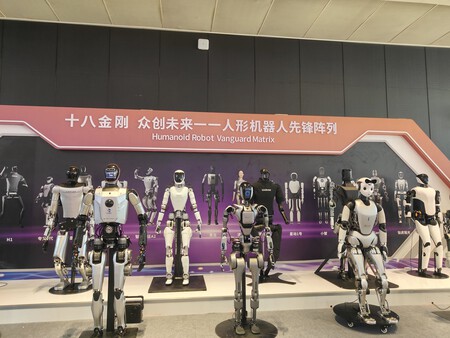
Unitree focused on motor expressiveness, showcasing robots capable of diverse tasks ranging from calligraphy to boxing, including a humanoid designed as a personal assistant. Deep Robotics highlighted its quadrupeds, which are currently operational in over 600 environments from electrical installations to educational venues. Keenon introduced the Bípedo Xman, targeting the service sector, while Cyborg Robotics unveiled the country’s first heavy-duty humanoid robot tailored for rigorous industrial applications.
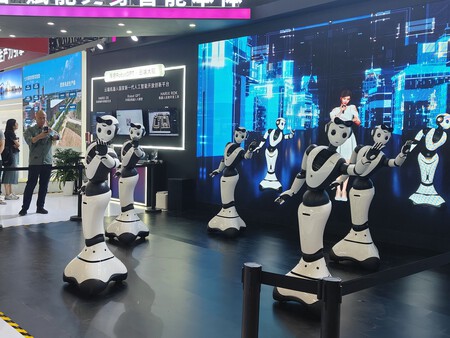
Humanoid robotics is undoubtedly at a crucial juncture. Jiang Lei, a pivotal figure in corporate development in China, stated that the industry is progressing from theory to practice. Today’s newer generations of robots are not merely programmed to follow, but can perceive their environment, perform real-time movements, and tackle complex tasks with millimeter precision. This advancement opens doors to real-world applications in sectors such as healthcare, commerce, and logistics, where accuracy is vital.
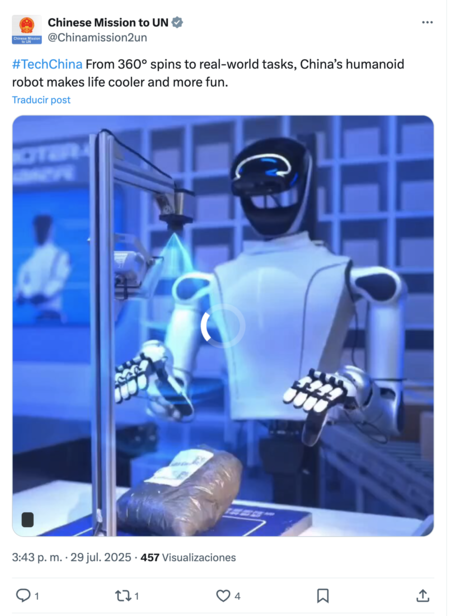
Click to see the original publication in x
Despite these remarkable achievements, significant challenges remain. The United States continues to lead in crucial aspects of humanoid movement, such as biomechanics and locomotive autonomy. Nonetheless, many experts believe that China is beginning to shine in other critical areas: large-scale production capabilities, widespread data accessibility, and rapid iterations. It’s not merely a race of algorithms; it’s about creating complete, functional systems.

Ultimately, China is not just focused on domestic production of robots; it aims to establish itself as an exporter as well. The event served as a platform to showcase this ambition. In emerging markets like Southeast Asia, technology from China is finding fertile ground. As demand grows for automated solutions in electronics, semiconductors, and industrial processes, Chinese manufacturers are responding with robust, reliable, and competitive offerings.