
| IN BRIEF |
|
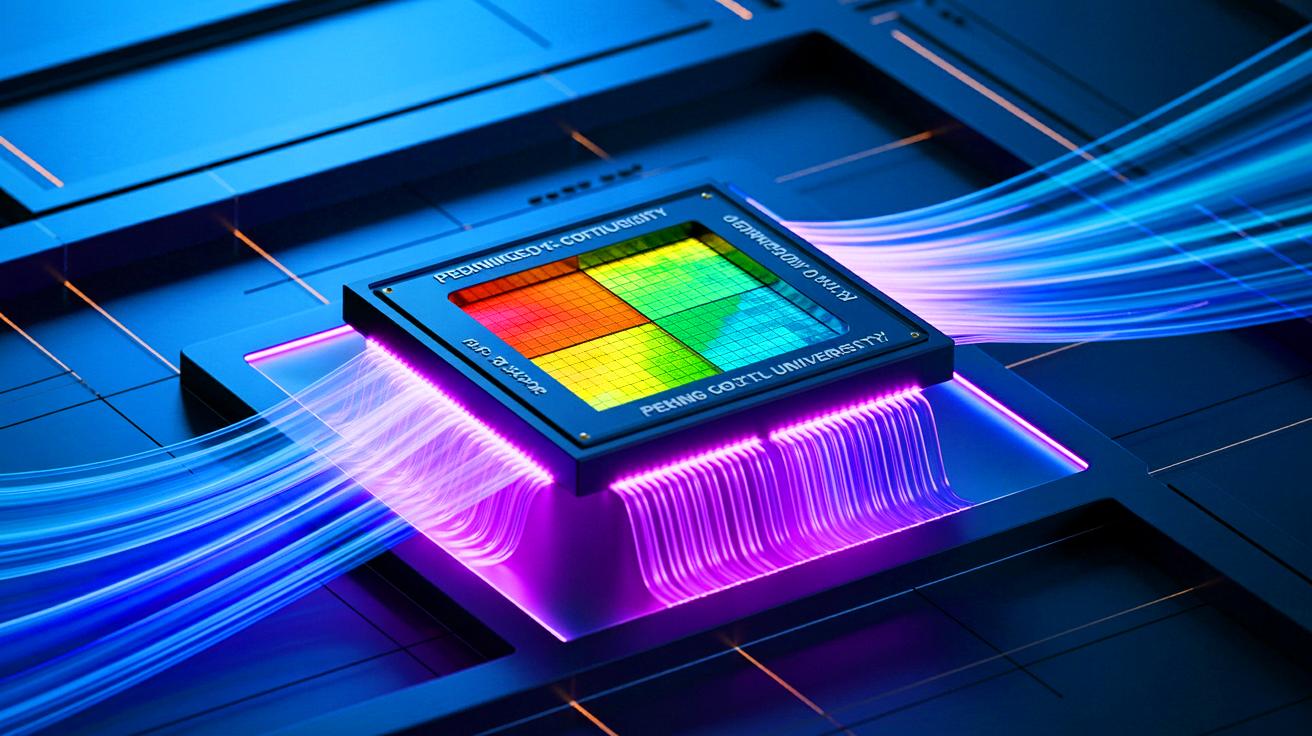
An international team of scientists, led by researchers from Peking University in China, has developed a revolutionary ‘ all-optical chip ’ capable of achieving clock speeds of up to 100 GHz . In contrast, conventional chips, which operate on electricity, typically reach speeds of only 2 to 3 GHz, peaking at about 6 GHz. This breakthrough could drastically change the way processors are used in everyday devices, ranging from smartphones to AI-powered chatbots.
How This Technology Works
According to Chang Lin, an Associate Professor at the Information and Communication Technology Institute of Peking University, traditional chips rely on electronic oscillators to generate clock signals. This process has limitations, such as excessive energy consumption, heat generation, and an inability to significantly increase clock speeds. Consequently, the researchers chose light as the medium for transmitting and processing information.
Photons travel much faster than electricity, allowing the clock signals generated by photons to process information at unprecedented speeds. By constructing a ring resembling a racetrack on the chip, the researchers timed each lap as a reference. Given that photons travel at the speed of light, each lap takes merely a few billionths of a second, enabling the clock to operate at ultra-high speeds.
Potential Applications of the Technology
Conventional chips function at a single clock speed, necessitating different chip configurations for applications that cannot be synchronized to those speeds. This requirement raises manufacturing and computing costs. In response, the researchers developed a “ microcomb ” integrated circuit capable of synthesizing both single-frequency and broadband signals, providing reference clocks for various electronic system components.
On a 20 cm wafer, the researchers claim to be able to manufacture thousands of these chips, ready for immediate consumer applications. For instance, this chip could power mobile communication across both 5G and 6G network bands. A significant advantage is that improving network speeds would not require a hardware upgrade for mobile phones if this all-optical chip is used. Similarly, implementing these chips in base stations would reduce equipment costs and energy consumption.
Impact on Artificial Intelligence and Autonomy
The higher clock speeds achieved with this chip translate into faster computations, essential for developing artificial intelligence in a more energy-efficient manner. The application of this technology in autonomous driving could enhance the accuracy and response time of systems. Thus, this innovation promises to transform not only mobile communications but also key sectors like AI and autonomous navigation.
The results of this research have been published in Nature Electronics , highlighting the importance of this technology in an increasingly connected and automated world.
A New Technological Era
This technological advancement could usher in an era where computing devices operate at previously unattainable speeds. The potential transition from 5G to 6G without hardware upgrades underscores the efficiency and cost-effectiveness of this all-optical chip. Moreover, by reducing energy consumption and associated costs, this innovation holds the potential for significant impacts across various industrial sectors.
Ultimately, this advancement raises a crucial question: how will this technology influence the future evolution of networks and computing capabilities in our daily lives?
The author has leveraged artificial intelligence to enrich this article.
Did you find this helpful? 4.4/5 (30)