
The Rise of Microwave Weapons: Inspired by Science Fiction
The idea of microwave weapons seems to leap out of the pages of science fiction, but recent developments indicate that we may be on the verge of a new era in military technology. As researchers explore ways to harness directed energy, the implications of such advancements are both fascinating and potentially alarming.
What Are Microwave Weapons?
Microwave weapons belong to a class of technologies known as directed energy weapons. Unlike conventional arms that rely on physical projectiles, these systems use concentrated energy beams to damage or neutralize targets. Specifically, microwaves are high-frequency electromagnetic waves that can heat materials, disrupt electronic systems, or cause direct damage to various infrastructures.
How Do Microwave Weapons Work?
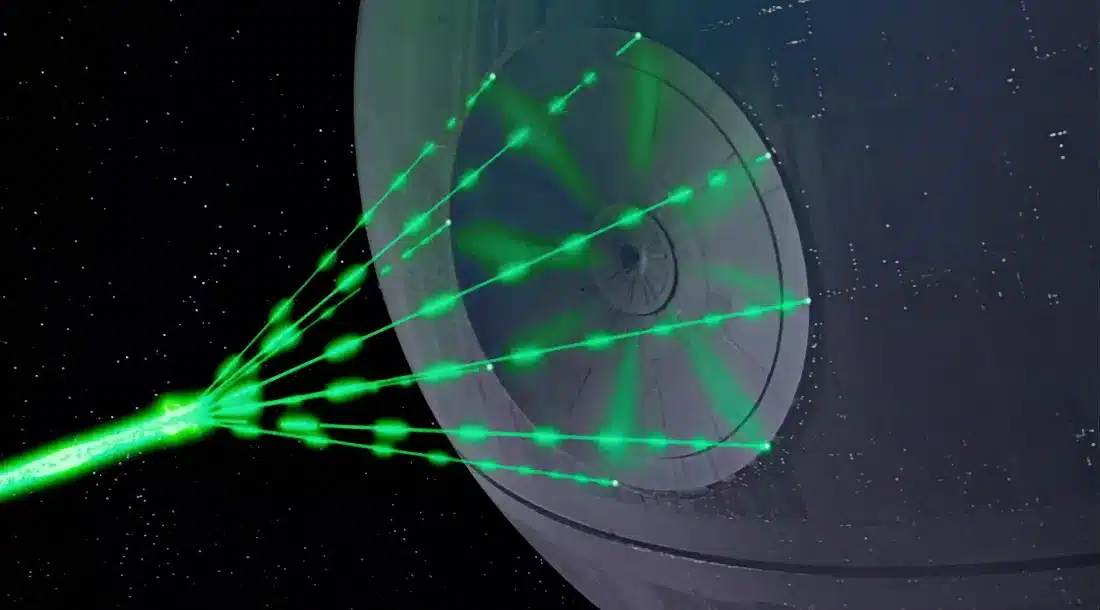
The innovative approach of a Chinese research team combines multiple mobile emitters instead of relying on a single source. Each emitter generates a distinct beam, and these beams are synchronized to converge with remarkable precision. When the waves come together, they create a more powerful concentrated beam directed at a specific target.
Overcoming Technical Challenges
Developing such an advanced weapon requires overcoming numerous technical hurdles. First, vehicles equipped with emitters must be positioned with millimeter accuracy. The Chinese system utilizes BeiDou technology, akin to GPS for positioning; however, the typical centimeter precision isn’t sufficient. Therefore, laser rangefinders have been integrated to adjust the positioning of the emitters with extreme accuracy.
Moreover, each emitter must emit its microwave beam with perfect synchronization, measured in picoseconds (one-trillionth of a second). This alignment is vital for ensuring that the waves strike the target simultaneously. Even a minor desynchronization could disperse the energy, significantly reducing the weapon’s effectiveness.
To maintain this level of precision, the researchers have interconnected the emitters using fiber optics that are controlled by a mobile command center. This centralized management ensures that the beams converge accurately.
Controversial Claims
According to the research team, the system can achieve a combined energy effect greater than the sum of its individual beams, referred to as "1+1>2". However, this assertion is contested, as it seems to contradict fundamental laws of conservation of energy.
In practice, what the researchers claim as an enhanced effect likely results from the concentration of energy into a single beam. This focused approach maximizes system efficiency by reducing energy dispersion, potentially allowing the beam to inflict more severe damage than several independent sources could achieve.
Credits: Lucas Films
The Limitations of Microwave Technology
Despite its promise, this weapon faces significant limitations. For one, microwaves can be easily dispersed by humidity or dust in the atmosphere, diminishing their intensity over long distances. This issue is amplified in open and uncontrolled environments. Moreover, powering such a system requires immense energy sources; current batteries are insufficient to provide the necessary continuous power output.
These constraints suggest that, while inspired by the Death Star from the Star Wars universe, this weapon is currently better suited for controlled environments like laboratories or testing facilities rather than military deployment.
Strategic and Ethical Implications
If these microwave weapons were to become operational, they could signify a major advancement in military technology. Hypothetically, such a weapon could neutralize critical infrastructure like communication centers or enemy drones without the mass destruction associated with conventional weapons.
However, the development of such technologies raises ethical and strategic questions. The deployment of directed energy weapons could lead to a new arms race among military powers. Additionally, these technologies could be used offensively to target civilian populations, electrical networks, or other vital infrastructures.
Conclusion
The announcement of microwave weapon technology showcases how science continues to draw inspiration from fiction. While the Death Star from Star Wars remains a futuristic vision, current advancements in microwave weapons reveal that the dreams of energy concentration are no longer entirely out of reach. Whether this technology will revolutionize warfare or remain confined to experimentation remains to be seen.
As we move forward, the intersection of innovation and ethical considerations will play a crucial role in shaping the future landscape of military capabilities.