
In the rapidly evolving technology landscape, the role of artificial intelligence (AI) has dramatically shifted since late 2022. While AI was previously integrated into everyday tools—like search engines and digital recommendations—it has now become a central theme that reshapes business strategies across various sectors. Major companies are restructuring their priorities around AI, reshaping their futures in response to an accelerated focus on this technology.
The Economic Stakes of AI Development
A critical observation about the current AI race involves the influx of capital dedicated to enhancing computational power. Corporations are investing heavily in chips, servers, and global data centers to sustain AI functionalities. Furthermore, nation-states, particularly the United States and China, are actively reinforcing their AI infrastructures to maintain a competitive edge. This environment of urgency raises concerns about the pace at which AI is developing compared to our comprehension of its implications.
Demis Hassabis’ Urgent Warning
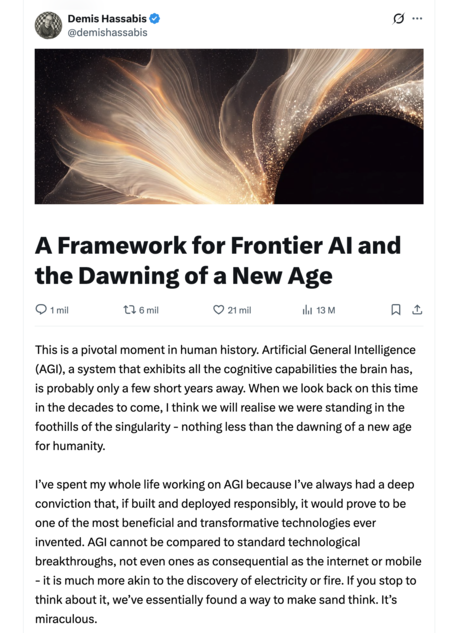
Demis Hassabis, co-founder and CEO of Google DeepMind, has emerged as a significant voice in this conversation. His track record includes groundbreaking projects like AlphaGo and AlphaFold, both pioneers in their respective fields. Following his recent Nobel Prize win, Hassabis’s commentary about AI carries considerable weight. He warns that we may be on the brink of achieving artificial general intelligence (AGI), a system exhibiting human-like cognitive functions, much sooner than anticipated.
The potential risks associated with AGI are manifold. Hassabis highlights concerns in areas such as cybersecurity, biological threats, and evolving autonomous systems that could function independently of human oversight. His stance presents a dual narrative: AI can offer unparalleled advancements in science and medicine, but it also necessitates the implementation of rigorous control mechanisms.
Establishing Oversight Mechanisms
In his detailed proposal, Hassabis argues for creating a specialized organization within the United States to evaluate advanced AI models. This entity would operate as a public-private partnership, involving independent experts and representatives from the open-source community. The organization would delineate what constitutes a frontier AI model and devise evaluations for assessing risks associated with cybersecurity and other critical areas.
Initial cooperation from AI labs could become mandatory, ensuring that any high-stakes model undergoes thorough evaluation before reaching the market. Hassabis suggests periodic reviews of these tests to accommodate new technologies and threats, advocating for a proactive approach to mitigating risks.
Caution from Industry Leaders
The concerns raised by Hassabis resonate with other prominent figures in AI. Geoffrey Hinton and Yoshua Bengio have also sounded alarms about our capacity to control progressively intelligent systems. In 2023, Elon Musk’s open letter calling for a six-month pause on training advanced AI systems underscores the growing recognition within the industry of the need for caution.
The Future of AI Regulation
The future modalities of AI remain uncertain, marred by a lack of consensus on the potential to maintain control over advanced systems. While some fears may appear exaggerated, the discussion around establishing effective regulatory frameworks, such as that proposed by Hassabis, stands as a crucial next step. As AI continues to impact our daily lives and the decisions made by corporations, the implications of this technology will require thoughtful oversight to avoid unforeseen consequences.
In summary, the discourse surrounding AI extends beyond technological advancements; it encompasses critical ethical, economic, and societal dimensions that demand our attention. With experts like Demis Hassabis leading the charge, the call for a balanced approach—where innovation meets responsibility—has never been more essential.