The scene is familiar for any passenger of a commercial flight in tourist class : a backpack between the legs, knees embedded against the frontal back, and a failed attempt to reach the floor of the cabin without hitting their forehead. What was previously an experience of discovery or luxury has degenerated, for most, into an awkward struggle for the most elementary physical space.
This transformation is not fortuitous; it began in the United States .
The Free Market
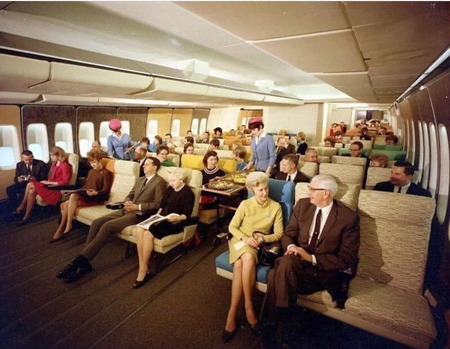
Before 1978 , airlines in the United States functioned as regulated public services. Basic rates, routes, and standards (including the space between seats and customer treatment) were supervised by the federal government. Tickets were more expensive than today but included services such as baggage , food , and seats designed for human comfort .
The Problem?
The frame changed drastically with the Airline Deregulation Act. The promise was that rates would fall and service would improve. In practice, the market rapidly consolidated, leading to an oligopoly where four airlines (American, Delta, United, and Southwest) now control 80% of the US market.
In this new competitive environment, operational efficiency took priority, and reducing passenger space became one of the most effective tools to increase margins without raising prices.
My Seat Diminishes
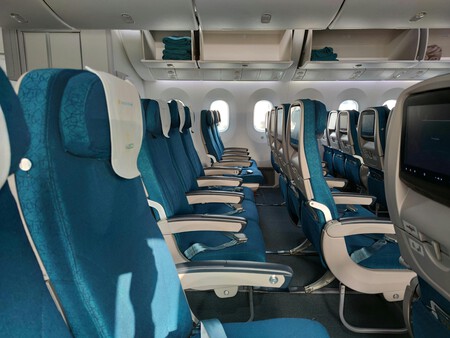
The evolution of seat space has been both progressive and constant . In the eighties, airlines offered an average of 90 cm space between seats (the pitch ), while today’s standard is about 80 cm , with low-cost carriers like Spirit or Wizz Air offering only 70 cm . Furthermore, seat widths have decreased by approximately 5 cm .
This reduction has reached a critical point: studies indicate that more than half of passengers do not fit comfortably in standard seats. The issue is particularly dramatic for overweight individuals, the elderly, and families traveling with young children—groups frequently excluded from safety testing used by the FAA to justify current standards.
It is not an illusion, this way it was traveling in economy class in the 70s
The Reduction in Europe
In Europe , the decline in passenger comfort began a bit later, around the 1990s, ignited by air liberalization which progressed in multiple phases between 1987 and 1997.
The key inflection point was the Third Liberalization Package (1992-1997), which allowed any EU airline to operate freely in the community space without restrictions on routes or rates. This led to the massive entry of low-cost airlines (Ryanair, Easyjet) and the indirect deregulation that saw standards for minimum seat dimensions relaxed.
We Are Bigger
Over the years, the issue has been compounded by the fact that the average size of the population has been increasing. According to the CDC , since the 1990s, the average weight of adult Americans has risen by more than 7 kg . Today’s women weigh what men did three decades ago; while height growth has stabilized, body sizes have increased .
Contrastingly, airline seats have not adapted to these changes, shrinking instead and challenging the trends in other sectors like automobiles, where accommodations have adjusted to consumer size. As Paul Hudson from Flyersrights states, the airlines have gone in the opposite direction of human evolution.
Ultimately, the compression of space is driven by a fundamental business logic: sell more tickets and maximize offerings. Airlines advertise extremely low fare basics but often force travelers to pay for extras under labels like “Economy Plus” or “Comfort.”
This has led to a system of aerial castes , where a small minority of frequent or business travelers enjoy acceptable conditions while the majority must endure claustrophobic spaces or pay more for services that used to be standard. Such conditions pose serious ethical questions regarding passenger treatment.
A crowded cabin is a common sight on modern flights.
Health Risks
The implications extend beyond comfort. Prolonged immobility in cramped spaces can significantly increase the risk of deep venous thrombosis , a condition that can result in potentially fatal pulmonary embolisms. The CDC recommends stretching or walking every two or three hours, which can be impractical during turbulent flights.
Additionally, overcrowded conditions can hinder evacuations , leaving passengers trapped in emergencies. The FAA mandates a maximum evacuation time of 90 seconds , yet tests undertaken have shown multiple flaws, including limited test group sizes and real-world scenarios.
How to Survive
With institutional action lacking, responsibility falls largely on passengers. Experts recommend booking seats with more space when possible for long trips or even purchasing two adjacent seats. Although, travelers must be cautious since airlines can reassign them unexpectedly.
Frequent movement and possibly utilizing anticoagulants under medical advice are also advisable. However, these solutions serve merely as band-aids in a system that has prioritized profit over passenger dignity.
An Expanding Legacy
Far from diminishing, the trend towards smaller seats is now more pronounced than ever. This phenomenon isn’t merely an anomaly; it’s a tangible manifestation of the economic model established post-1978. A model that has turned the passenger into a customer , and the flight into a commodified market.
Profit margins are maximized at the expense of the crucial personal space necessary for comfort and safety. While airlines claim that safety is their priority, shrinking seats and crowded cabins only increase risks. What began as a promise of choice has ultimately led to a dramatic restriction of physical space, making flying increasingly claustrophobic.