
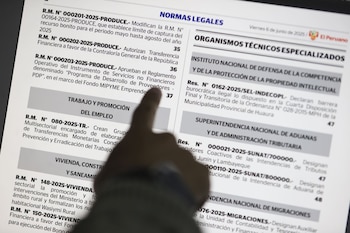
The bulletin Legal Standards of the Official Gazette El Peruano, the official source of the Peruvian State for the publication of laws, decrees, and resolutions of general scope, issued a set of provisions with significant implications on crucial areas such as mining, financial inclusion, humanitarian aid, migration, and identity promotion. These regulations aim to fortify the control mechanism against illicit activities, broaden banking access, enhance transparency in emergency response, support an important international agricultural meeting, and acknowledge those who advocate for the right to identity in the country.
Law No. 32412: Stricter Control in Mining
The Law No. 32412 was published by the Congress of the Republic, establishing stringent measures aimed at controlling the distribution, transport, and marketing of chemical supplies that could be used in mining activities, specifically regarding illegal mining. The overarching goal of this law is to prevent the diversion of these chemical substances towards illegal operations, which represents a severe issue in regions like Madre de Dios . Here, the use of toxic substances like mercury for gold extraction has resulted in significant environmental destruction, pollution of water bodies, and detrimental effects on local communities.
This law introduces a comprehensive system of registration, control, and oversight covering all phases of the chemical inputs’ lifecycle—production, import, storage, transport, distribution, marketing, use, and disposal. By closing existing loopholes, this regulation aims to bolster the development of formal mining , a pivotal source of fiscal revenue and legitimate employment within Peru.
Law No. 32413: Digital Wallets for Financial Inclusion
Another crucial regulation is the enactment of the Law No. 32413, which officially permits the utilization of digital wallets for settling transactions for assets and various labor obligations across both private and public sectors. This law endeavors to expand inclusive financial tools and facilitate universal access to digital services. In a country marked by a notable banking gap—where approximately 50% of adults had an account with a financial institution as of 2021, according to World Bank data—the introduction of digital wallets stands as a significant stride towards formalization and reduction in cash transactions.
Employers can now leverage digital wallet applications like YAPE , PLIN , or equivalent platforms to distribute salaries, thereby enhancing efficiency and convenience for workers.
Guidelines for Humanitarian Aid Transparency
The Presidency of the Council of Ministers (PCM) granted approval to the Ministerial Resolution No. 157-2025-PCM, establishing directives for regional governments concerning the procurement, inventory management, distribution, and care of humanitarian aid goods. These protocols are devised to ensure transparency and efficiency during emergency responses documented in the National Information System for Response and Rehabilitation (SINPAD).
Moreover, the standard and its guidelines will be made available on the Single Digital Platform of the Peruvian State for Citizen Orientation and the digital portals of both the PCM and the National Institute of Civil Defense. This initiative facilitates thorough monitoring by citizens and oversight agencies alike.
International Collaboration on Agricultural Biodiversity
The Ministry of Agrarian Development and Irrigation (MIDAGRI) also took a decisive step by crafting a temporary multisectoral working group through Ministerial Resolution No. 0264-2025-MIDAGRI to organize the upcoming Eleventh Meeting of the Governing Body of the International Treaty on Phytogenetic Resources for Food and Agriculture (TIRFAA) set to occur in Peru in 2025. TIRFAA is a treaty of the FAO (Food and Agriculture Organization of the United Nations) focused on conserving and sustainably utilizing essential phytogenetic resources vital for global food security.
This working group will oversee all related activities, underscoring the importance of agricultural biodiversity and Peru’s commitment as a megadiverse nation committed to the conservation of traditional seeds and varieties.
Modernizing Immigration Management
On the immigration front, the Foreign Ministry ratified the Supreme Decree No. 024-2025-RE, laying down regulations for the Integrated Immigration Management System and Immigration Risk Evaluation (SIGME). This technological system aims to enhance Peruvian immigration management by conducting more efficient risk evaluations while securing the nation’s borders. The regulation comprises 30 articles segmented into seven chapters, set to be published on various official State digital platforms, streamlining processes in response to complex migratory phenomena.
Recognizing Contributions to Identity Promotion
Lastly, the National Identification and Civil Status (RENIEC) established the JEFATURAL RESOLUTION No. 000122-2025/JNAC/RENIEC, aiming to acknowledge identity forgers. This honour is designated for individuals and institutions actively promoting the fundamental right to identity within Peru—a pivotal aspect for accessing rights and services. The Reniec Communications and Press Office will manage this initiative, aiming to enhance awareness around the significance of identity, especially among vulnerable groups such as rural or Amazonian communities.
The recent legislative measures reflect Peru’s commitment to tackling challenges in key societal areas while fostering a more secure, inclusive, and organized social structure. Consequently, these advancements are likely to play a transformative role in the country’s future.