
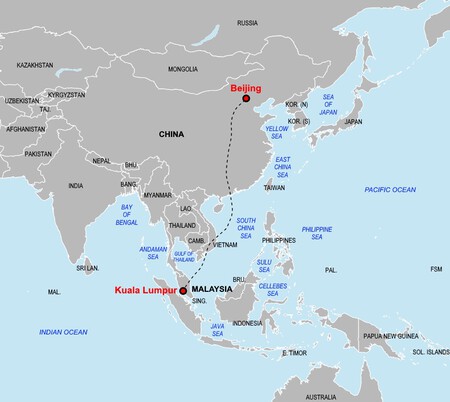
On March 8, 2014, Malaysia Airlines flight MH370 disappeared, marking one of the most profound mysteries in aviation history. This Boeing 777-200ER was carrying 239 individuals when it left Kuala Lumpur International Airport, bound for Beijing. Just after its last communication at 1:19 AM, the plane seemingly vanished from radar. Despite extensive international search operations over the past 12 years, its fate remains unknown, prompting a third search mission to resume.
Timeline of Disappearance
Flight MH370 took off at 12:41 AM on March 8, 2014, and was expected to land in Beijing at 6:30 AM. The last message from Captain Zaharie Ahmad Shah, “Good night Malaysian three seven zero,” was received just before the aircraft deviated from its planned flight path. Radar data indicated it turned west over the South China Sea before vanishing from secondary radar at 1:21 AM.
Unanswered Questions
Despite the aircraft’s communication systems being disabled, it continued to send satellite signals. The British company Inmarsat, utilizing the Doppler effect, tracked the plane moving southward. The Australian Transport Safety Bureau’s (ATSB) final report confirmed the aircraft flew for over six hours until fuel exhaustion, suggesting it ended up in the remote southern Indian Ocean.
The Search Operations
The initial search, considered the most expensive in aviation history, was undertaken from 2014 to 2017, covering 120,000 square kilometers primarily around the “Seventh Arc.” Despite significant investment from multiple countries, including $44 million from Australia, the search concluded without recovering the fuselage or a definitive explanation for the disappearance. Subsequent investigations indicated that the change in course could not be attributed to technical failure or weather conditions, implying a deliberate action.
Debris Findings
Over the years, more than 30 pieces of debris confirmed to belong to MH370 have been found, primarily along the coasts of East Africa and various islands such as Réunion and Madagascar. Yet, no human remains were discovered, leading investigators to assume that all on board perished during the incident.
A New Search Initiative
In a recent development, the Malaysian government has authorized a renewed search in collaboration with Ocean Infinity, a robotics company. This operation, set to last 55 days, aims to explore a targeted area of 15,000 square kilometers in the Indian Ocean. Utilizing state-of-the-art technology, including autonomous underwater vehicles equipped with multibeam sonar and HD cameras, the mission seeks to create 3D maps of the seabed to locate any remains of the aircraft.
Aiming for Closure
As the search resumes, hopes are high for closure for the families impacted by this tragedy. While the possibility of a deliberate act has not been ruled out, various hypotheses, including theories of hijacking or other nefarious activities, continue to emerge.
As we reflect on the absence of reliable evidence surrounding MH370’s disappearance nearly 12 years ago, the determination to uncover the truth remains strong, reigniting interest in one of aviation’s greatest unsolved cases.