

Manzhouli: The Strategic Nexus Between China and Russia
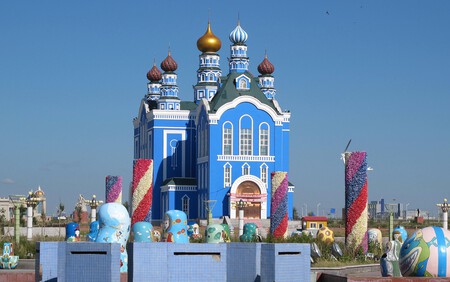
On the map of Manzhouli, a small point north of Inner Mongolia stands out. This city, with a population similar to Las Palmas, boasts a picturesque square filled with replicas of Russian monuments and giant Matryoshka dolls , including a stunning 30-meter-high one that doubles as a hotel. However, beyond its visual appeal lies a crucial logistics node on the China-Russia border. As Moscow’s economy distances itself from the West, the importance of Manzhouli has significantly increased, making it a vital artery for sustaining the Russian economy amidst the ongoing turbulence from geopolitical conflicts.
Some analysts suggest that Manzhouli is playing a fundamental role in sustaining the Russian economy during these challenging times. As reported by sources, this northern city has attracted attention from major news outlets and analysts alike. Lisa Visentin , a correspondent for *The Sydney Morning Post*, and Keith Bradsher , head of *The New York Times* bureau in Beijing, have both made the journey to evaluate the significance of this sub-prefecture.
A Unique Location with Economic Implications
With only 382,000 inhabitants , Manzhouli is far from being a bustling metropolis, yet its strategic positioning has garnered significant international interest. It serves as a bridge between China and Russia , particularly during a critical juncture as the Russian economy faces severe sanctions. This unique geographical location enhances the city’s potential in the Sino-Russian relationship amidst the long-standing diplomatic and economic tensions following the Ukraine War.
Trade Routes and Economic Growth
The importance of Manzhouli’s infrastructure cannot be overstated. The city houses an extensive network of roads and rail lines, including a railway built in the early 1900s that facilitates trade between Beijing and Moscow . Today’s commercial activity caters to the transfer of goods—trains and trucks travel daily, carrying wood, essential materials for construction, and other goods. These deliveries help Beijing diversify its import sources and lessen reliance on North America, despite the ongoing sanctions against Russia.
A staggering 65% of all bilateral land-based trade between China and Russia passes through Manzhouli, according to a report by *Global Times*, which highlights the significance of this border port. When trade was suspended for several weeks due to COVID-19 measures, local businesses expressed their frustrations over monumental financial losses, underscoring the economic dependency on this trade route.
Enhancing Industrial Capabilities
Manzhouli is transitioning from being merely a traffic hub to an influential industrial center . The city is undergoing transformations and is becoming a site for processing wood , among other materials. Trains from all over China arrive here, acting as a crucial junction that connects Chinese freight to international markets, including Europe.
Economic interactions between Beijing and Moscow have intensified, with the combined imports and exports reaching historical highs in recent years. In 2024 alone, the total trade volume between the countries reached nearly 240 billion euros , reflecting a remarkable growth trajectory. Significantly, since Russia’s military actions in Ukraine, exports to China have surged, accounting for almost 6% of the Russian economy.
The Fragility of Economic Ties
While the Sino-Russian relationship appears to flourish, it is not without friction. Entities in Moscow insist that processed goods, such as timber, are to be utilized domestically, while China has recently imposed tariffs on certain Russian imports to nurture its own economy. Despite overcoming challenges around currency transactions by using Renminbi or Rubles for trade, competitive tensions remain evident.
In essence, Manzhouli stands as a testament to the evolving dynamics of global trade , shaped by geopolitical uncertainties. It showcases not only the strategic interdependence between China and Russia but also the complex interplay of cooperation, competition, and adaptation that characterizes their economic relationship.
As global affairs continue to unfold, Manzhouli’s role as a pivotal player on the geopolitical chessboard will likely amplify. Thus, this seemingly quiet city on the border is anything but ordinary—it’s a strategic juggernaut reshaping the economic landscape for both nations.