
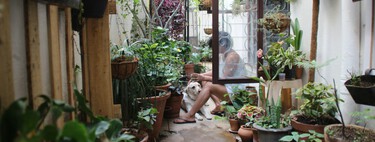
In bright, filtered light, shelves once filled with books have transformed into an unexpectedly lush business area: the world of collectible plants . We are not just speaking of exotic flora; we refer to plants with unique patterns and impossible hybrids. In this niche market, some plants can cost more than a pair of Vision Pros, and enthusiasts with discerning eyes—and even better gardening skills—are turning their hobby into a lucrative business . If you’re seeking rare plants, don’t head to a nursery; instead, check out Wallapop.
However, despite the market teeming with enthusiasts willing to pay surprising sums for certain species, the big question remains: Can you make a living selling plants? We spoke with two such enthusiasts to delve deeper into how their hobby has evolved into a business.
The Rising Trend of Indoor Plants
During the pandemic, many people turned to hobbies like baking bread or working out at home . Others, however, discovered their passion among pots and cuttings. The interest in exotic plants or urban gardening predates the pandemic and makes perfect sense, especially in urban settings. Filling a home with greenery goes beyond decoration; it addresses a need to connect with nature. Given the context of lockdowns, this trend exploded.
Simultaneously, the boom of ‘plantfluencers’ on Instagram contributed to this snowball effect that continues to grow. For example, it was through a book by @plantitiscrónica , a well-known influencer, that Vivi (on Instagram @viviyverde ) got started in the world of plants. Though her following was significantly smaller then, she’s since taken the plunge into cultivating rare specimens, particularly Alocasia , which she sells on Wallapop.
On the other hand, Sergio (on Instagram @sergiodendron ) was inspired by Sidney Plant Guy . By watching his videos, he learned how to grow plants like Philodendron and Epipremnum to monstrous sizes.
From Collecting to Cultivating
The issue with collecting plants in apartments is space. This challenge prompted Sergio to begin selling some of his plants. In nature, many of these tropical species climb trees to seek precious light. The moss pole aims to replicate these conditions, and as Sergio humorously states, “They grow giants quickly; my home was overflowing.” When a plant becomes too tall, he has to cut it and extend the pole . What does he do with the cuttings? With no room left at home, he started selling them.
Collecting plants in apartments poses a challenge: space. This led Sergio to sell some of them.
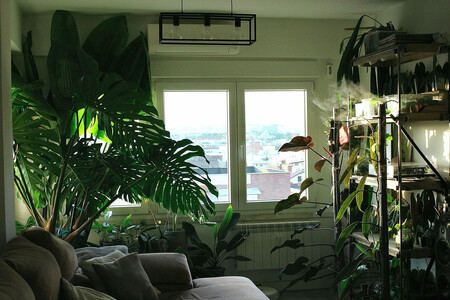
Sergio’s living room is an authentic jungle.
Once he reached his limit of moss poles, he turned to Anthurium , one of the trendiest species in plant collecting. Although he admits to being relatively new to growing this species, he is captivated: “It’s a highly diverse genus. What’s special is that they’re easy to hybridize between different species.” He often purchases his plants from other European countries and creates his hybrids in his Madrid apartment, many of which he sells on Wallapop.
When asked how many plants he has at home, he responds with another question: “What do you consider a plant? I have tons of little ones, but I also have large ones that count.” He estimates he has over 300 plants , with 70 being larger, and the rest small sprouts.
For Vivi, transitioning from collecting to selling was more intentional. After spending time collecting and creating content about plants, she recognized the market and set up a growing shop. Currently, she has two cultivation areas in her apartment, primarily cultivating Alocasia . She has over 200 plants in her home.
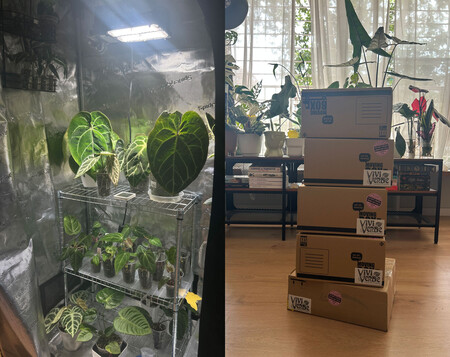
To the left: One of Vivi’s cultivation setups. To the right: Orders for the week ready to go.
Vivi also sells on Wallapop , but her Instagram showcases a more professional approach. She has a logo, invests significantly in packaging, and even offers merchandise. One vital aspect she enjoys is packaging the plants, emphasizing that they must arrive in perfect condition. “Shipments should be sent on Mondays or Tuesdays. If sent later, the plant might spend the weekend in a warehouse and arrive in poor condition.”
Another crucial factor to consider is the legal side. Selling plants within the European Union is legal and does not require any special permits, but importing from other countries necessitates a phytosanitary certificate. “It’s a hassle,” Sergio remarks. Since last year, Wallapop reports to tax authorities, so earnings must be declared, and sellers need to register as self-employed.
The Most Coveted Plants
What are currently the most expensive plants? Tropical plants attract collectors, with species like Philodendron , Anthurium , Alocasia , and Monstera being among the most common. However, not just any specimen will do; it must be a rare species, and if it features a unique variegation, even better. Variegation in botany refers to a condition where a plant exhibits tissues of various colors or structure. For example, a Monstera albo variegata has the classic ‘Adam’s rib’ look but with white spots. The whiter and more attractive the pattern, the higher the price.
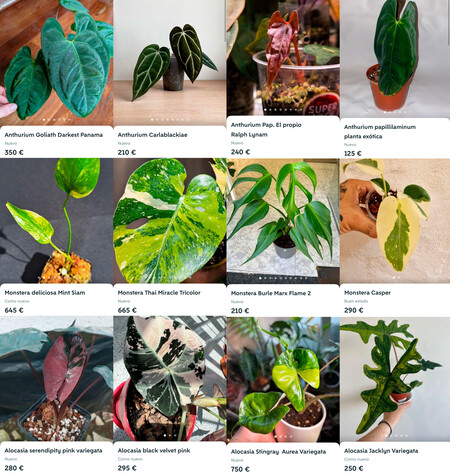
Wallapop is filled with rare tropical plants, and some are not cheap.
However, not all plants of the same type have the same value. For instance, a Monstera Thai constellation may cost as low as 60 euros (or more, depending on size), while a Monstera Thai constellation miracle tricolor can exceed 600 euros. What’s the difference? The latter features a pattern showcasing green, white, and yellow, a rarity (or miracle, as its name suggests) that sky-rockets its cost.
The trend for Alocasia and Anthurium continues to rise. There are 113 species of Alocasia and over 1,000 species of Anthurium , with new hybrids continually emerging , some created by enthusiasts right in their homes. The rarer the result—especially if it features multicolored variegation or mutations—the better. While you may find some hybrids on Wallapop, they won’t be the most expensive ones. Trying sites like Aroid Market (an Indonesian store) can lead to finds like this variegated Anthurium priced at over 3,000 dollars.
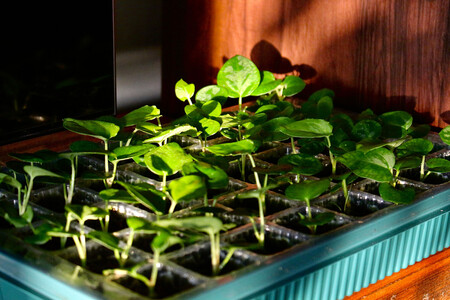
Some of the Anthurium that Sergio cultivates at home.
Sergio has dabbled in hybridization and successfully crossed several Anthurium species, although he admits the results are unpredictable and from the same cross, very different plants may emerge . It’s also possible to cross Alocasia , though there’s less species compatibility, making it trickier. Plus, “Alocasia is delicate; many people struggle to keep them alive,” he adds with a laugh.
Currently, one sought-after plant is the Alocasia black velvet pink , which inspired Vivi to start her cultivation journey. She appears to have succeeded, as she now sells her seedlings for around 120 euros. While she cultivates Anthurium as well, her fondness for Alocasia is unmistakable. Browsing Wallapop, we found rarer and pricier specimens, all variegated, like this Alocasia stingray aurea for 750 euros .
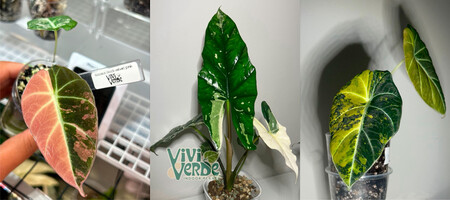
Some of the Alocasia that Vivi has for sale. On the left, the ‘black velvet pink.’
If this seems pricey to you, in places like the United States or certain Southeast Asian countries, some specimens cost more than a car. Two years ago, a Monstera Devil Monster was sold in Thailand for 40,000 dollars. If someone has an extra 49,000 dollars, they can buy this variegated Anthurium papillilaminum sinam fire. It’s crucial not to forget to water them!
A Niche and Ever-Changing Business
In the world of plants, rarity commands a high price, yet as with any market, what is rare today may be commonplace tomorrow . In the U.S., Walmart sells variegated Monstera plants for 30 dollars , a price unimaginable just a few years ago. In 2019, a Philodendron pink princess could set you back hundreds of dollars, whereas I recently bought one at Aldi for just 6 euros, pot included.
In 2019, a Philodendron pink princess cost hundreds of dollars. Recently, I purchased one at Aldi for 6 euros, pot included.
The buying and selling of collectible plants in Spain lags behind other European countries. Vivi notes that in the Netherlands and Germany, it’s common to find some in physical stores, a rarity in Spain today. These collectors have turned to platforms like Wallapop as a means to earn cash or at least finance their hobbies, but the big question is how long this will last.
The market is quite dynamic, but Sergio sees ample potential. “Plants are a highly abundant resource , and new hybrids or strange mutations will keep appearing.” As in other markets, new trends will emerge : “In Southeast Asia, ferns like ‘elk horns’ are highly sought after, and in Taiwan, they are crazy for some variegated orchids .”
Can You Make a Living From This?
The further we stray from the mainstream , the more limited the audience becomes. When discussing rare plants, few know them, and even fewer are willing to purchase one. Furthermore, the pricier the plant, the fewer interested buyers there are. However, it’s also true that the supply isn’t broad. Plants do sell . “The rarest and most expensive plants sell quickly, especially the variegated ones,” Vivi asserts. Sergio concurs: “Special plants fly off the shelves, but pricing them right is crucial.”
“You could potentially live off Instagram (as an influencer) but not from selling plants unless you turn it into a store.”
The million-dollar question remains. While there might be individuals willing to pay hundreds of euros for a corm of Alocasia , whether one can genuinely sustain themselves from this is a different narrative. Sergio believes it’s unlikely, at least not in Spain; in contrast, he sees it as more feasible in countries like the U.S.: “You could live off Instagram (as an influencer), but not from selling plants unless you establish a store.” He has no intention of starting a business, but he has made his hobby sustainable: “I finance the plants I buy with those I sell.”
Vivi acknowledges that she’s just begun and is far from making a living from it, though she doesn’t rule it out. She also agrees that establishing a store and a more robust infrastructure would be essential to thrive.

It may not be a highly lucrative business, but it undeniably involves a passionate component that is crucial for success. Caring for plants is a skill that can be developed. Vivi had little knowledge of plants when her boyfriend gifted her a Sansevieria , yet today she cultivates Alocasia , which are notoriously difficult to maintain. Sergio says it plainly: “If you’re in it solely for the money, you will likely fail. It takes a lot of time and effort to recreate favourable conditions.”
Image credit: Vivi Bilale (@viviyverde)