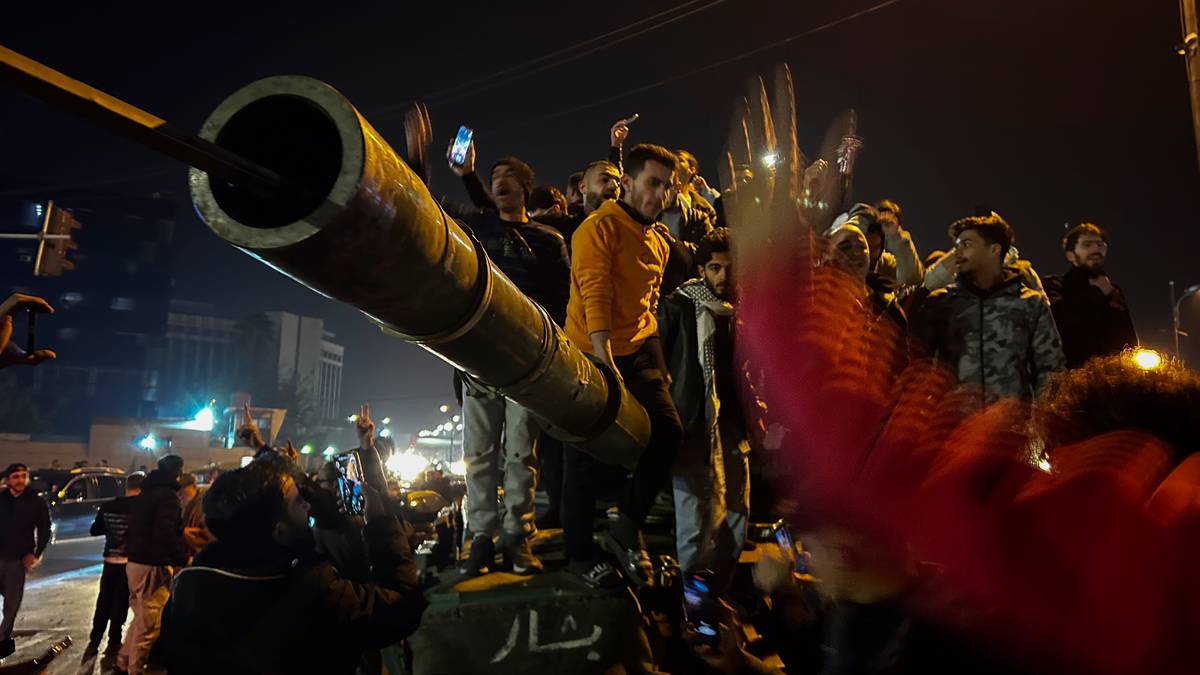
Bashar al-Assad’s time as Syria’s leader is over. It ended, as it often does with authoritarian leaders and dictators, on a plane out of the country. Humiliated and abandoned. The thin, tall man who once came with hope for a new future has, through thirteen brutal years, clung to power. Now it’s over. His fall has been lightning fast. The big cities have fallen like dominoes. First, out of the blue, fell Syria’s most populous city and economic center, Aleppo. Besieged, bombed and starved, the World rubbed its eyes and wondered what happened. For far too long, the international community has left Syria to itself. The rebels then raced south along the main road, meeting little or no resistance. Hama was the next city. The city where thousands of members of the Muslim Brotherhood were killed in 1981. Then Homs, the place where the uprising against Bashar Al-Assad gained momentum in 2011 and which paid the price. 2012: Syrians demonstrated against al-Assad’s regime while burying their own. Photo: Reuters It was here that it became clear that the regime would not make any agreements, but would fight with all means. They besieged, bombed and starved districts. Mercilessly. So last night Damascus fell, so to speak, without a stroke of the sword. Damascus is one of the Middle East’s most important cities and one of the world’s oldest. Rebel forces celebrated Sunday by firing into the air in Damascus. Photo: Abdulaziz KETAZ / AFP The historical museum in the city houses the world’s first alphabet. In the Old Town is the beautiful Umayyad Mosque. Once a Roman temple, a church before Damascus fell under Muslim rule and became the capital of an Arab empire in the 6th century. There is thus a deep historical significance to what is now happening and 8 December 2024 ushers in a new era. Two questions emerge. What happens now? And how could the Assad regime fall so quickly? Everything got worse To take the last first. The Assad family has dominated Syria since a military coup in 1970. It too was a time of political instability, but Hafez al-Assad, Bashar’s father, established a brutal police and surveillance state that controlled the country with an iron fist until he died in 2001, handing power to his son, Bashar al-Assad. When the Arab Spring came to Syria, it was clear that Bashar was his father’s son. His regime responded to the peaceful demonstrations with brutal violence. After that, everything only got worse. And more complicated. A Syrian man was subjected to violence by the Syrian regime. Photo: JAMES LAWLER DUGGAN / Afp The uprising turned into a civil war with a number of groups and actors, and many other countries intervened, and the war was forced along sectarian and religious lines. The Assad family belongs to a minority. They are Alawites, a side branch within Islam, and gradually gained more and more support from the Shia Muslim countries in the region. Hezbollah in Lebanon and Iran supported the regime, while Arab countries supported groups that were predominantly Sunni. The Western countries supported the rebel movement in the beginning. There is also a Christian minority in Syria where some sought the secular part of the uprising against Assad, while others chose the incumbent regime and the protection that came with it. The Kurds are also an important population group and they gradually took control in their own areas. In the middle of the chaos, one of the world’s most extreme terrorist groups was also formed. The Islamic State. The Assad regime faltered several times. I was in Aleppo myself in 2015. Then the regime held a small part of the city and barely managed to keep the supply lines open. The soldiers fighting in the old town were tired and cold. The civil war in Syria had been going on for four years in 2015. Then the country was left in ruins. Photo: Sigurd Falkenberg Mikkelsen / news It was not until Russia seriously sided with the regime with air support that the balance of power tipped in their direction. But the war was never over. The world just chose to look the other way. The rebels were pushed into a small slice of Syria, while the regime’s grip on the areas they controlled became weaker. The economy was disastrous and drug trafficking eventually became an important source of income for the regime. Dissatisfaction grew and quietly the rebellion grew again. And when the pressure mounted, this time no one was willing to die for Bashar al-Assad and his regime. Developments outside Syria were also decisive. Russia has more than enough with its war of aggression in Ukraine, while Hezbollah and Iran are greatly weakened after the war with Israel in the past year. When the rebellions pushed on from the north, they too left Bashar al-Assad alone. This changes the balance of power in the Middle East. Iran is weakening. So does Hezbollah’s grip on Lebanon. The symbolism in the image is clear. President Bashar al-Assad has reportedly left Damascus. Photo: OMAR HAJ KADOUR / AFP What now? It will strengthen Arab countries and Turkey, but also extremist groups will see this as a victory. Israel gets an uncertain border, but gains strategically from Iran being pushed out of Syria. How will things be in Syria now? Hayat Tahrir al-Sham (HTS), the group leading the insurgency has had ties to Al Qaeda and is among Western countries’ terrorist groups. They nevertheless send very clear signals about moderation and caution. Minorities must be protected. Public institutions must not be touched. It seems they are trying to negotiate a peaceful takeover. So far, there has been remarkably little violence. This shopping street in Damascus was full of people on December 6, in the middle of the major offensive. Photo: LOUAI BESHARA / AFP But HTS is not alone. There are many armed groups that will now be involved in deciding, and Syria is historically very difficult to govern. The Islamic State is not completely gone. We also do not know where HTS’ real motives are. The Kurds also have an important role to play, and the US still has a bridgehead in the country. It was complicated before, and it will become more demanding in the future as well. A rosy scenario is that Syria’s population finds its spirit from the first months of 2011. Back then, many thought they could stand together for a better and freer future. But after so many years of war and conflict, it is probably more likely that the country’s hard-pressed population will have to prepare for more uncertain times. Published 08.12.2024, at 11.01 Updated 08.12.2024, at 11.19
ttn-69