
| IN BRIEF |
|
The race for technological innovation in the field of electric vehicles has taken a new turn with the development of the axial flux motor by Mercedes-Benz. This advancement is set to radically impact the design of electric sports vehicles, offering spectacular performance while adhering to modern ecological imperatives. This article will explore the revolutionary aspects of this technology and the challenges it presents.
The Axial Flux Technology: A Revolutionary Architecture
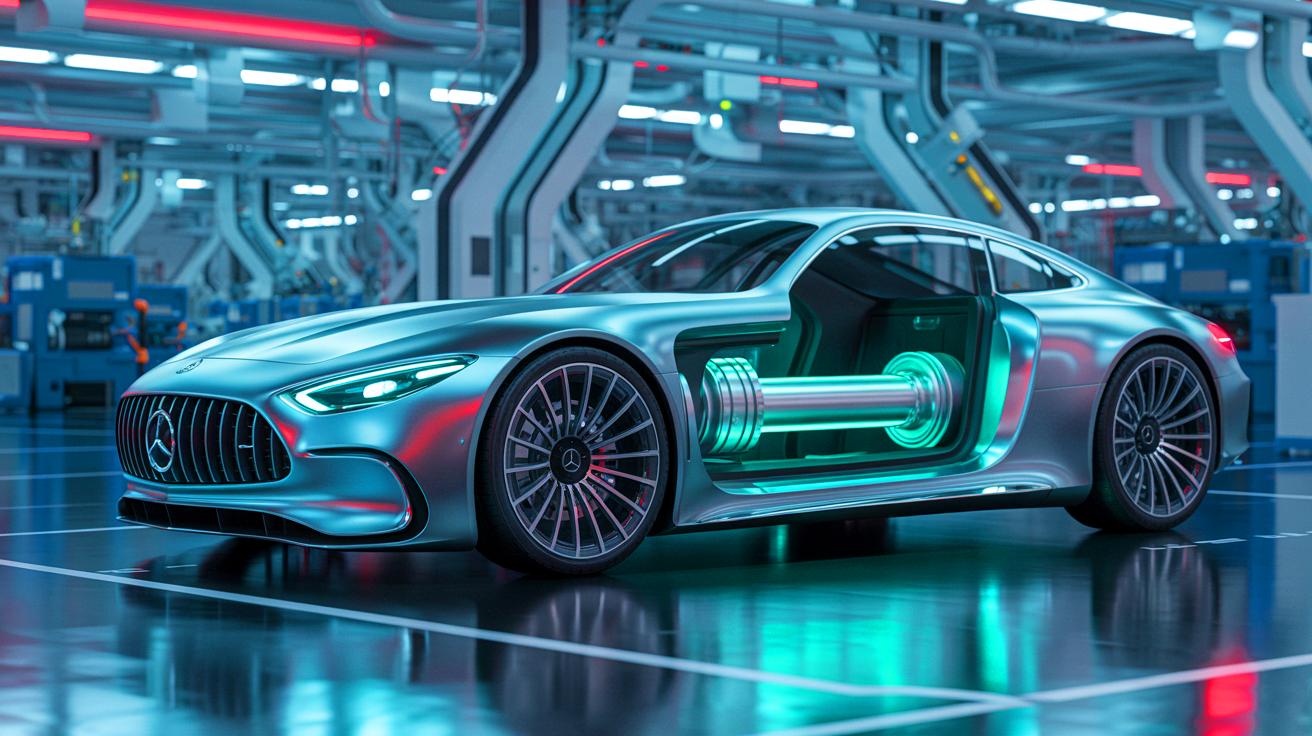
The axial flux motor represents a significant technological advancement compared to conventional electric motors. In a traditional motor, known as a radial flux motor , the structure dictates a cylindrical design, thus limiting certain performance aspects. In contrast, the axial flux motor, with its flat disk-shaped structure, unlocks unprecedented possibilities. This architecture not only significantly reduces weight and footprint but also optimizes power density.
The axial flux motors developed by Mercedes-Benz are three times more compact and lighter than their traditional counterparts while retaining an ideal magnetic contact area. This results in a spectacular increase in performance, with rumors suggesting over 1,000 horsepower for the future AMG sports sedans. The integration of this technology with 800-volt batteries promises unparalleled performance, redefining expectations for electric sports vehicles.
British Heritage and Industrial Challenges
This innovation has its roots in the acquisition of Yasa, a British startup recognized for its axial flux motors used in some high-end hybrid models. Mercedes-Benz has thus inherited valuable expertise, but scaling up production for 100% electric vehicles poses a significant challenge. The production of these motors requires complex industrial processes, many of which are genuine global innovations.
Advanced techniques, such as laser surface treatments and the use of artificial intelligence for component inspection, illustrate the complexity of this technology. Copper coils, formed from rectangular wires, maximize electrical density, necessitating custom tooling for precise handling. These innovations showcase Mercedes-Benz’s capability to overcome considerable industrial challenges to achieve a new standard in electric motor production.
Mastering Extreme Physical Constraints
A key technical challenge lies in the attachment of magnets to the rotor of the axial flux motor. These components must withstand immense centrifugal forces, equivalent to the weight of an entire car. To ensure their safety and efficiency, Mercedes has developed ultra-strong bonding techniques, complemented by rigorous quality controls.
| Feature | Radial Flux Motor | Mercedes Axial Flux Motor |
|---|---|---|
| Shape | Cylindrical | Flat (disk-type) |
| Weight | Standard | Reduced by approximately 66% |
| Volume | Standard | Reduced by approximately 66% |
| Power Density | Normal | Superior |
| Chassis Integration | Standard | Lowest possible position |
This new technology will initially be reserved for high-end AMG models due to the complexity and costs associated with its production. However, Mercedes-Benz envisions democratizing it in the future by optimizing manufacturing processes to make it more accessible.
Global First and Future Perspectives
The prospect of seeing this revolutionary technology in mass-produced vehicles as early as 2026 marks a global first for Mercedes-Benz. The company is committed to an ambitious electrification strategy that aims to combine exceptional performance with environmental sustainability. This strategy goes beyond merely replacing internal combustion engines with electric ones, fully exploiting the unique advantages of electric propulsion.
The upcoming electric AMG models, based on the AMG.EA platform , will integrate this innovation, promising an unparalleled driving experience. As engineers at Berlin-Marienfelde fine-tune the final details, the question remains: how will this advancement influence the future of the automotive industry and the perception of electric sports vehicles?
The author has relied on artificial intelligence to enhance this article.
Did you enjoy this article? 4.4/5 (27)