
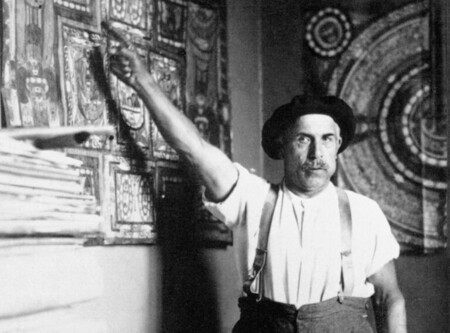
The Enigmatic Life of Adolf Wölfli
In 1921, Swiss psychiatrist Walter Morgenthaler published a book that sparked a revolution in the perception of art and mental illness. The title, which seemed a contradiction, highlighted one of his inmates, Adolf Wölfli, a mentally ill patient who turned out to be a remarkable artist. Wölfli, confined to the Waldau asylum for over two decades, never realized the monumental impact of his work, which André Breton would later rank among the most significant of the 20th century.
Adolf Wölfli: Early Life and Mental Illness
Born on February 29, 1864, near Bern, Wölfli’s life took a dark turn when he was condemned for sexual assault against minors, leading to his institutionalization in 1895. Diagnosed with paranoid schizophrenia, he spent 35 years at Waldau, confined to a mere seven-square-meter cell. Despite this restrictive environment, Wölfli produced a staggering body of work: 1,460 drawings, 1,560 collages, and approximately 25,000 pages of writings, including texts and original music.
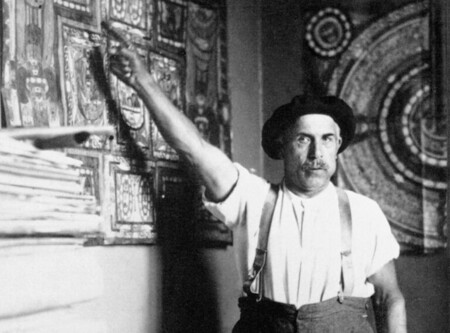
A Profound Artistic Journey
Wölfli’s creativity found expression in his multi-layered autobiographical work, ‘Von der Wiege bis zum Graab’ (‘From the Cradle to the Grave’), consisting of over 3,000 pages created between 1908 and 1912. He also compiled geographical and algebraic notebooks (1912-1916) and song and dance notebooks (1917-1922) encompassing about 7,000 pages. A unique aspect of his creations was his self-evolution through personas, transitioning from Doufi the boy, to the Knight Adolf, and even to Saint Adolf II, with each drawing accompanied by innovative musical notations.
The Catalyst: Walter Morgenthaler
The artistic resurgence of Wölfli can be attributed to Walter Morgenthaler, who joined the Waldau asylum in 1907. Unlike other psychiatrists, Morgenthaler recognized Wölfli’s artistic impulse as a valuable outlet rather than a symptom to be suppressed. His groundbreaking 1921 monograph, ‘Ein Geisteskranker als Künstler’ (‘A Mentally Ill Person as an Artist’), highlighted Wölfli’s works, attracting interest from both psychiatric circles and the avant-garde artistic community.
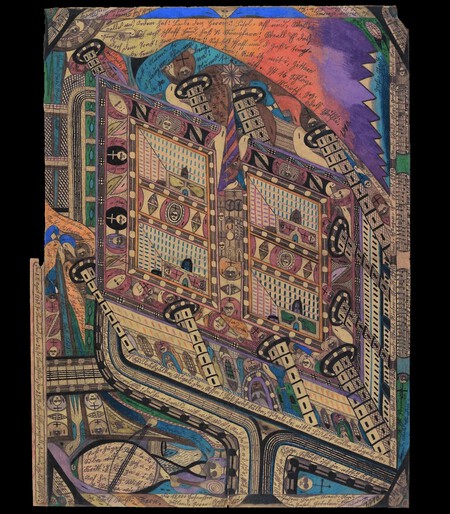
The Legacy of Art Brut
In 1945, Jean Dubuffet discovered Wölfli’s work and dubbed him “the great Wölfli”. This recognition played a significant role in the founding of the Compagnie de l’Art Brut, which would serve as a forum for untrained artists. André Breton later lauded Wölfli as one of the century’s most crucial artists. The spotlight on his work culminated in 1972 when Swiss curator Harald Szeemann showcased Wölfli’s pieces at Documenta 5, alongside a reconstruction of his cell.
Ongoing Discovery and Archiving
Since Wölfli’s passing in 1930, much of his 25,000-page oeuvre remains scattered across archives and private collections. The foundation dedicated to preserving Wölfli’s legacy works tirelessly to document new findings and continues to receive inquiries from collectors validating pieces from original notebooks. Each rediscovered item reshapes our understanding of this prolific yet confined artist, revealing a rich tapestry of creativity developed within the confines of an asylum.
Wölfli’s journey from obscurity to recognition serves as a crucial reminder of the intricate relationship between mental health and artistic expression, challenging preconceived notions and emphasizing the power of creativity in the face of adversity.