
The Battle of Midway: A Historical Context
Japan designed the Battle of Midway convinced that the distance and dispersion of its fleet gave it a strategic advantage. However, the United States had already deciphered Japan’s plans, turning that distance into a trap in 1942. Four Japanese aircraft carriers sank in a matter of hours—demonstrating that in naval warfare, distance does not guarantee safety.
Retreat is No Longer a Refuge
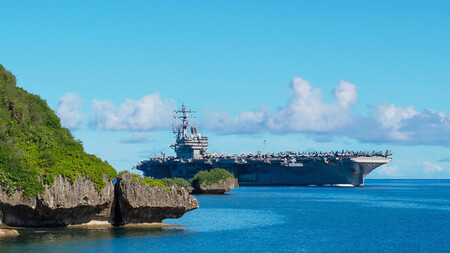
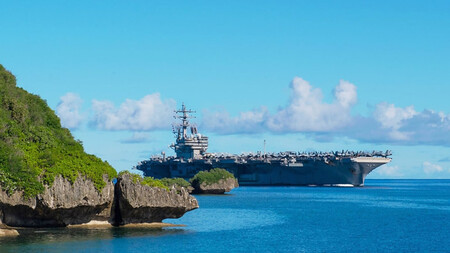
For years, the United States has responded to China’s increasing military presence in the Pacific by moving its aircraft carriers and naval assets further away from the Asian coast. The rationale seemed logical: the greater the distance from Chinese ballistic, hypersonic, and cruise missiles, the harder it would be for them to be destroyed. Bases like Guam transformed into strategic sanctuaries. However, Beijing has made it clear that distance no longer ensures security.
The Chinese Manual of Naval Warfare
A group of Chinese military scientists, led by Gao Tianyun from the National University of Defense Technology in Nanjing, has published a study outlining methods to destroy a U.S. aircraft carrier battle group from 3,000 kilometers away. This distance is nearly identical to the span between Shanghai and Guam. The study’s ambition suggests a significant threat: Washington’s chosen refuge for its valuable vessels is now within China’s operational range.
The Great Chain of Death
Rather than proposing a “miracle weapon,” the Chinese study details a comprehensive targeting system. This includes the utilization of satellites, drones, radar aircraft, submarines, and ships to continuously monitor enemy naval groups. Once a target is identified, a swarm of coordinated missiles—capable of sharing data in-flight—would be unleashed, enabling precise attacks from multiple angles.
A War of Exhausting Defenses
The Chinese strategy focuses on undermining the defensive architecture that protects American aircraft carriers. The U.S. naval groups rely on systems like the Aegis destroyers and CIWS systems, which serve as the last line of defense. However, these defenses are limited, and the coordinated missile swarm aims to exploit those limits, draining the defense mechanisms of time and resources.
Hiding is No Longer Enough
The central concern for Washington is that merely dispersing its ships and relocating them further from the Chinese coast is no longer an effective strategy. The Chinese study warns that effective detection and tracking can nullify the advantages of distance, transforming it into merely a logistical variable.
The Complexity of Modern Warfare
Although the Chinese strategy sounds formidable, executing it is no simple task. Maintaining precise targeting data on a moving naval group that employs camouflage, electronic interference, and decoys is a significant challenge. Hitting a moving target from 3,000 kilometers away remains one of the most complex endeavors in modern warfare.
More Message Than Capacity
Ultimately, the Chinese study serves more as a strategic signal than a technical capability. It communicates a clear message to Washington: moving aircraft carriers further away may alter their position, but it does not resolve the underlying threat. Distance does not equate to safety; even thousands of miles away, no target is truly “out of reach.”
In summary, the implications of this new strategic landscape indicate that as warfare evolves, traditional tactics such as distance and concealment may no longer suffice in safeguarding crucial military assets.
Image | US Navy
In Xataka | While the world looked at Iran, China has seized an island in the Pacific without a single shot. And now he is militarizing it.
In Xataka | Japan has crossed a red line in the Pacific with the US: China has just responded with warships closer than ever.