
Summer is here, bringing with it the desire of millions to escape the city. The urge to immerse oneself in the beach, leisure, or serene rural landscapes goes beyond mere enjoyment; it encompasses a pressing need to escape the heat . At the heart of this quest lies the urban heat island effect, a phenomenon that significantly impacts urban living.
What is the Urban Heat Island Effect?
The term “heat island” refers to the fact that cities tend to accumulate heat , resulting in temperatures often higher than those in surrounding areas. This effect is particularly pronounced at night, when the difference between urban temperatures and those of the surrounding environment can be striking.
In cities like New York, estimates suggest a temperature difference of about 4 °C compared to its outskirts. A recent study conducted across five Spanish cities revealed that while Madrid had an average variation of 1.3 °C , Valencia showed a staggering 4.1 °C difference. In some cases, the difference could reach up to 11 °C between the city center and its peripheral zones.
<img alt="Heat accumulation in cities" width="375" height="142" src="https://i.blogs.es/b4356e/guia-de-imagenes-destacadas/375_142.jpeg"/>How Do Heat Islands Occur?
The causes of urban heat islands are varied . Construction materials utilized in urban settings tend to absorb heat during the day, releasing it slowly during the night. This means nighttime temperatures in cities do not drop as much as in less developed areas, leading to heat accumulation.
Additionally, buildings obstruct airflow that might otherwise carry heat away. The absence of vegetation and factors like soil water evaporation exacerbate poor thermal regulation in urban environments.
Human activity also plays a significant role in urban warming. Daily activities such as driving and operating heating systems generate residual heat. Even air conditioning units create a positive thermal balance , contributing further to the heat problem.
What Factors Aggravate the Problem?
Not every city experiences an urban heat island to the same extent. The complexity of contributing factors gives rise to a variety of impacts . Here are a few factors that can influence a city’s thermal profile:
Population density, street orientation and structure, building characteristics (height and materials), and vegetation all play roles. The presence of water bodies and geographic features like mountains or coastlines can also affect how a city interacts with its thermal environment. Interestingly, even the color of buildings , including roofing, affects temperature differentials.
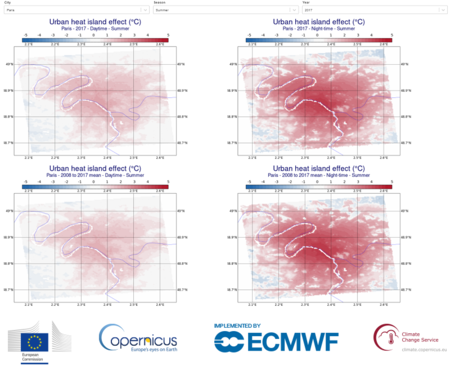
The urban heat island effect in the city of Paris (Image Credit: Copernicus Climate Change Service, ECMWF).
Consequences of Heat Islands
The direct consequence of this phenomenon is an increase in temperatures, which affects various aspects of everyday life for urban residents. Both day and night, heat impacts health and well-being, leading to something as serious as heat strokes and hindering our ability to concentrate or sleep.
Additionally, there is a heightened risk of suffering from certain health conditions, particularly cardiovascular issues . While urban heat can be an asset in winter, in summer it generally means higher cooling costs for homes, workplaces, and even refrigerators.
A Problem That Will Escalate
Two prevailing factors suggest that the urban heat island effect and its consequences may worsen in the years to come. The first is climate change . The global rise in average temperatures, coupled with urban heat accumulation, amplifies the risks associated with this phenomenon.
The second concern is the rural exodus , as increasing urban populations amplify the risks for larger cities. The more people reside in these areas, the greater the vulnerability to elevated temperatures and associated impacts.
How to Prevent the Heat Island Effect?
With urbanization ongoing, especially in developing nations, it’s essential to seek solutions to mitigate the impact of heat islands. Understanding their causes and dynamics is fundamental to developing effective strategies.
Possible solutions include promoting architectural designs that optimize airflow and reduce heat-retaining materials. Leaving spaces for natural environments such as parks and urban forests is critical as well.
Introducing greenery in established urban areas can help mitigate heat. Even simple additions like trees along streets can significantly lower ground-level insolation. Painting roofs white or reflective colors can also contribute to reducing urban heat.
By actively addressing this pressing issue, cities can strive to create livable environments for all inhabitants, making summer a time for enjoyment rather than discomfort.