
A Shift in Military Strategy: U.S. Attack on Drug Traffickers in the Caribbean
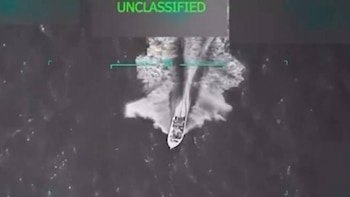
A military attack by the United States in the Caribbean Sea has escalated tensions with Venezuela following the destruction of a high-speed boat. U.S. authorities claim the boat was transporting drugs and manned by alleged members of the notorious Aragua Train criminal organization. This incident, which occurred on September 1, 2025 , near San Juan de Unare in the Sucre state, has led to significant political and social reactions in both nations.
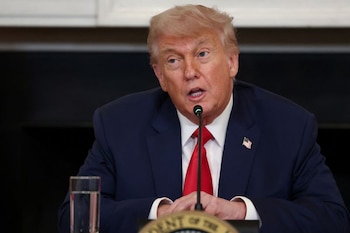
The operation, conducted in international waters close to Venezuelan territory, involved a missile strike, reportedly launched from a drone, according to experts consulted by The Country America . Footage of the attack, released by the U.S. government and later circulated on social media platforms by former President Donald Trump , shows the boat exploding post-impact without any preceding engagement.
U.S. authorities argue that the vessel was on its way to Trinidad and Tobago carrying a shipment of narcotics, and identify its occupants as belonging to the Aragua Train , a transnational criminal organization with significant operational footholds in the region.
According to U.S. officials, including Secretary of State Marco Rubio and Secretary of Defense Pete Hegseth , the operation was meticulously planned with precise targeting of individuals identified as Aragua Train affiliates. “We knew exactly who was on that boat. We knew exactly what they represented: Aragua’s train,” Hegseth stated during a television interview, as reported by Caracol News . Trump further endorsed the military action, framing it as a decisive message to drug cartels and affirming ongoing military engagement in the Caribbean .
Conversely, the Venezuelan government reacted swiftly. President Nicolás Maduro condemned the attack as a blatant act of aggression and called for national mobilization, asserting that millions of Venezuelans would rally to support the military if escalation were to occur. Communication Minister Freddy Ñáñez speculated on social media that the footage of the attack could have been manipulated using artificial intelligence , but many local residents have refuted this claim, emphasizing the tragic reality of the event.
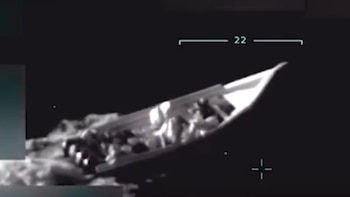
The Whistle, a Venezuelan news outlet, provided additional context about the ill-fated vessel. It was identified as a “flipper,” measuring 12 meters and powered by four 200-horsepower engines . The boat departed from San Juan de Unare on August 31 , headed for Trinidad and Tobago , with a crew of eleven men , eight of whom were local residents. Tragically, the owner of the boat lost his son in the assault, as he was one of the crew members. Additional reports indicate that two other drug-laden boats successfully navigated the same route before the attack, evading interception.
Authorities in both the U.S. and Venezuela have yet to officially confirm the identities of the deceased or the claimed association with the Aragua train. The Prime Minister of Trinidad and Tobago , Kamla Persad-Bissessar , voiced her support for the U.S. military action, stating the immense pain caused by drug cartels in the region.
The impact of this attack resonates deeply within San Juan de Unare—a community afflicted by poverty and violence exacerbated by decades of organized crime. Videos and condolences regarding the victims have flooded social media, where local residents mourn their lost community members, rejecting the narrative surrounding the use of AI in the attack video.
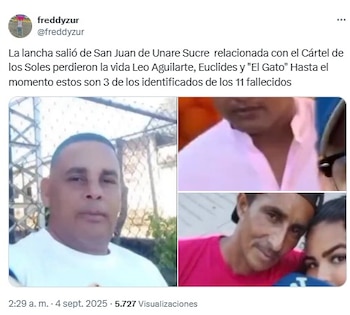
Images of alleged victims are circulating on platforms like TikTok , while a strong military presence has further heightened the community’s distress, according to testimonies gathered by The Country America . The San Juan de Unare area has historically served as a major transit point for drug trafficking and, more recently, human trafficking, amid the broader Venezuelan exodus toward the Caribbean .
According to journalist Ronna Rísquez , who has investigated the Aragua Train , the area is “ overwhelmed by drug trafficking ,” with the gang’s influence glaringly visible in everyday life. Notably, a 2019 report from Insight Crime documented the rise in maritime piracy along the eastern coast of Venezuela, which serves as a gateway for cocaine and marijuana trafficking to the Caribbean, especially between Venezuela and Trinidad and Tobago.
This attack signifies a notable shift in U.S. strategy against drug trafficking within the Caribbean. Ryan Berg , director of the Americas Program at the Center for Strategic and International Studies , stated that the operation exemplifies a transformation in operational rules, akin to military actions addressing piracy in the Gulf of Aden or terrorism in the Sahel . The United States has recently classified the Aragua Train and other cartels as terrorist entities, amplifying military pressure in the Caribbean, which has subsequently strained diplomatic relations with Venezuela . While U.S. officials maintain that the military action was a legitimate measure against drug trafficking and a deterrent to cartels, Amnesty International has called for an investigation, citing potential violations of international law.
As the people of San Juan de Unare grapple with the loss and turmoil, violence and drug trafficking remain persistent challenges that overshadow the region. Amidst this ongoing strife, community members mourn their lost loved ones while questioning the implications of such military interventions.