

While Spain does not currently possess F-35 fighters, it is on the brink of enhancing its naval defense capabilities with the upcoming delivery of the Bonifaz frigate. This is the first of the F110 class frigates, and its structural stress test was recently completed at Navantia’s shipyard in Ferrol. What’s even more impressive is that the United Kingdom has entrusted Navantia with the construction of its next frigate, positioning the company as a leading player in military naval construction.
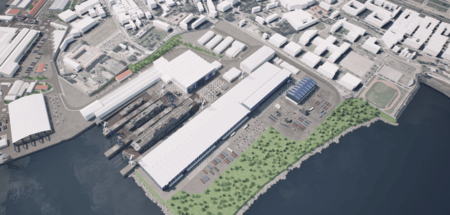
A Naval Milestone for Spain. Navantia’s investment in the Ferrol shipyard represents the largest modernization effort in a century. The establishment of the Digital Block Factory (FDB) aims to position Spanish military naval construction at the forefront of global technological innovation.
With a staggering budget of 110 million euros, this plant will span 45,000 square meters and will enable the Galician shipyard to double its production capacity. The implementation of Shipyard 4.0 —characterized by automation, artificial intelligence, and robotics—marks a significant evolution in naval shipbuilding.
The Timeline. The inauguration of the FDB is set for the first quarter of 2026. The construction process kicked off in March 2024 and has included the creation of a digital twin to monitor the project’s progress, manage costs, and predict any potential issues.
Unprecedented Production Capacity. The new factory will be capable of building in just one year what is equivalent to the blocks needed for a vessel like the Juan Carlos I, as well as two F-110 frigates, four European corvettes, and additional logistical support vessels, effectively streamlining the shipbuilding process.
In practical terms, the plant will facilitate the simultaneous construction of two frigates, executing one section every ten days, which amounts to approximately 26 sections annually. This efficiency is projected to reduce construction timelines by 20-25%. For the F-110 project, about 85% of each unit’s structure will be fabricated in the FDB, while critical components will still be produced in traditional workshops, aligning with commitments to the Spanish Navy as well as potential export contracts .
Embracing Automation, AI, and Robotics. The factory layout is divided into three principal areas: steels, pre-armament, and flip. In the first area, robotic welding lines employing hybrid laser technology will guarantee precision and durability. In the pre-armament phase, components will be moved autonomously using unmanned vehicles equipped with IoT sensors.
Finally, in the assembly zone, blocks will be linked with subcomponents using an automated system that emphasizes speed and reliability. This entire operation will be supported by a system that ensures complete digital traceability. Each part will generate data linked to its digital twin, enabling real-time adjustments and monitoring via smart cameras connected to 3D models.
The Innovation and Robotics Center. Navantia’s digital transformation extends beyond the factory itself. The Innovation and Robotics Center (CIR) is directly linked to the FDB and serves as a technological hub where groundbreaking innovations in automation, advanced welding, and dimensional control are tested.
Acting as both a development space and a training ground, the CIR ensures that developments are seamlessly integrated into production processes, bolstered by collaborations with local universities and experts.
Labor Impact. It’s important to note that despite the high level of automation, Navantia has assured that the factory will maintain a workforce of between 270 and 400 employees, encompassing both direct and auxiliary workers. Each shift will include between 300 and 325 staff, illustrating that robotization is viewed as a supportive tool rather than a replacement for human jobs.
A Military Reference. When complete, the FACILITY will set a global standard in military ship construction. The only comparable facility is the German Meyer Werft Shipyard , which has gradually implemented automation over 15 years for luxury cruisers. However, Navantia aims to be the first to apply this industrial logic to warships, enabling the company to offer high-quality products at competitive speeds—a fundamental requirement in the defense sector.
An additional benefit is that the capability to produce blocks for other international shipyards will enhance Navantia’s role within the global naval supply chain.
A New Era at the Estuary. With this ambitious project, Navantia aims to transform Ferrol into a global reference point for military naval construction, merging tradition and modernity in a venture that symbolizes a pivotal shift in Spanish industrial history. As highlighted by Rafael Morgade, the executive in charge of digital transformation at Navantia, this marks a “new era” as the Galician shipyard transitions from a century of disorganized growth to a more concentrated and technologically advanced model.
In a geopolitical climate characterized by rearmament, this mega-factory not only enhances the capabilities of the Spanish Navy but also positions Navantia as an elite partner in the international defense market .