
As Iran and Israel continue to exchange attacks, the United States has begun to reinforce its military presence in the Middle East . Secretary of Defense Pete Hegseth confirmed via a post on X that he had ordered “the deployment of additional capabilities” to protect its forces and enhance defensive posture in the region.
According to details from sources like Reuters and BBC, the deployment includes the USS Nimitz aircraft carrier, a key asset of the U.S. Navy. It can carry up to 5,000 personnel and over 60 aircraft , including fighters, light bombers, and support planes.
Additionally, at least 30 tanker aircraft have been mobilized, primarily KC-135 Stratotankers and KC-46 Pegasus , alongside a fleet of fighters including F-16 , F-22 , and F-35 models.
Aircraft Carrier, Fighters, and an Unanswered Question: The B-2
Amidst this escalation, many eyes are on a question that hovers over U.S. strategy: will the B-2 Spirit stealth bomber be deployed? This question has a clear reason. The B-2 is the only aircraft under direct U.S. control certified to transport and launch the GBU-57/B Massive Ordnance Penetrator , a bomb designed to penetrate deeply buried structures.
This capability is not just a technical detail. According to various estimates, the GBU-57 could be one of the few weapons capable of reaching Fordow , the Iranian uranium enrichment facility buried under a mountain, about 80 to 90 meters deep.
No one has confirmed it, but the presence of the B-2 Spirit looms large over discussions. The mere possibility of the U.S. mobilizing it is enough to alter the strategic conversation. Justin Bronk, an analyst at the Royal United Services Institute, made it clear: the current type of deployment is “highly indicative” that Washington is preparing to support “intensive combat operations” in the region.
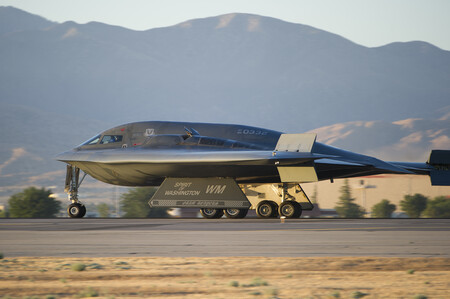
The B-2 would be the most significant asset in this backing. Its range of 9,650 km without refueling allows it to operate from key locations. It typically flies from Whiteman Air Force Base in Missouri, but other viable options include Fairford in the UK and Diego Garcia , a remote base in the Indian Ocean leased by the UK to the U.S.
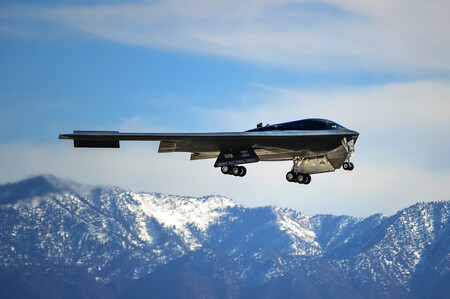
Although the B-2 is not the fastest or the newest bomber, it is one of the most difficult to detect. Its flying wing design, combined with special materials and a low flight profile, allows it to penetrate highly sophisticated air defense systems. This is precisely where its value lies: it can operate in areas where others cannot.
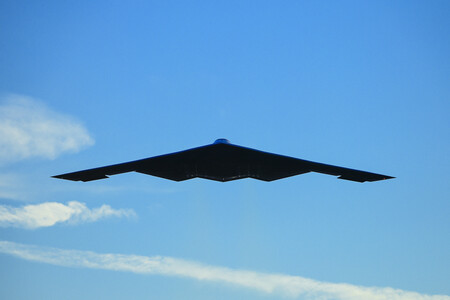
It has a wingspan of 52 meters and is 21 meters long, powered by four General Electric F118-GE-100 engines. It has a maximum operational altitude of 15,000 meters , and as mentioned earlier, an intercontinental range. Its payload capacity is approximately 20 tons , capable of carrying both conventional and nuclear armament.
The B-2 is crewed by two personnel, significantly fewer than other heavy bombers like the B-1B or B-52 , and its missions are coordinated from a limited network of strategic bases. Maintenance is managed by the U.S. Air Force, with support from contractors led by Northrop Grumman . Shockingly, only 19 units are active .
The B-2 began flying in 1989 and is not a resource to be deployed lightly. Its value lies not only in the technology making it undetectable but also in its ability to combine stealth, range, and strike power in a single platform. It is, in many ways, the card saved for the end of the game.
Images | U.S. Air Force (Via Wikimedia Commons) Northrop Grumman (1, 2, 3)
As the situation in the Middle East continues to evolve and tensions rise, the implications of U.S. military strategy remain profound. The potential deployment of advanced assets like the B-2 Spirit could serve not only as a tactical advantage but also as a powerful message to adversaries in the region. Understanding these dynamics is essential for grasping the broader geopolitical landscape and the future of military engagements in this crucial area.