
The Two Faces of the Public Television Tax War: Hacienda’s Forgiveness to RTVE and Judicial Struggles for 300 Million from Regional Channels
Disparities in the Public Broadcasting Landscape
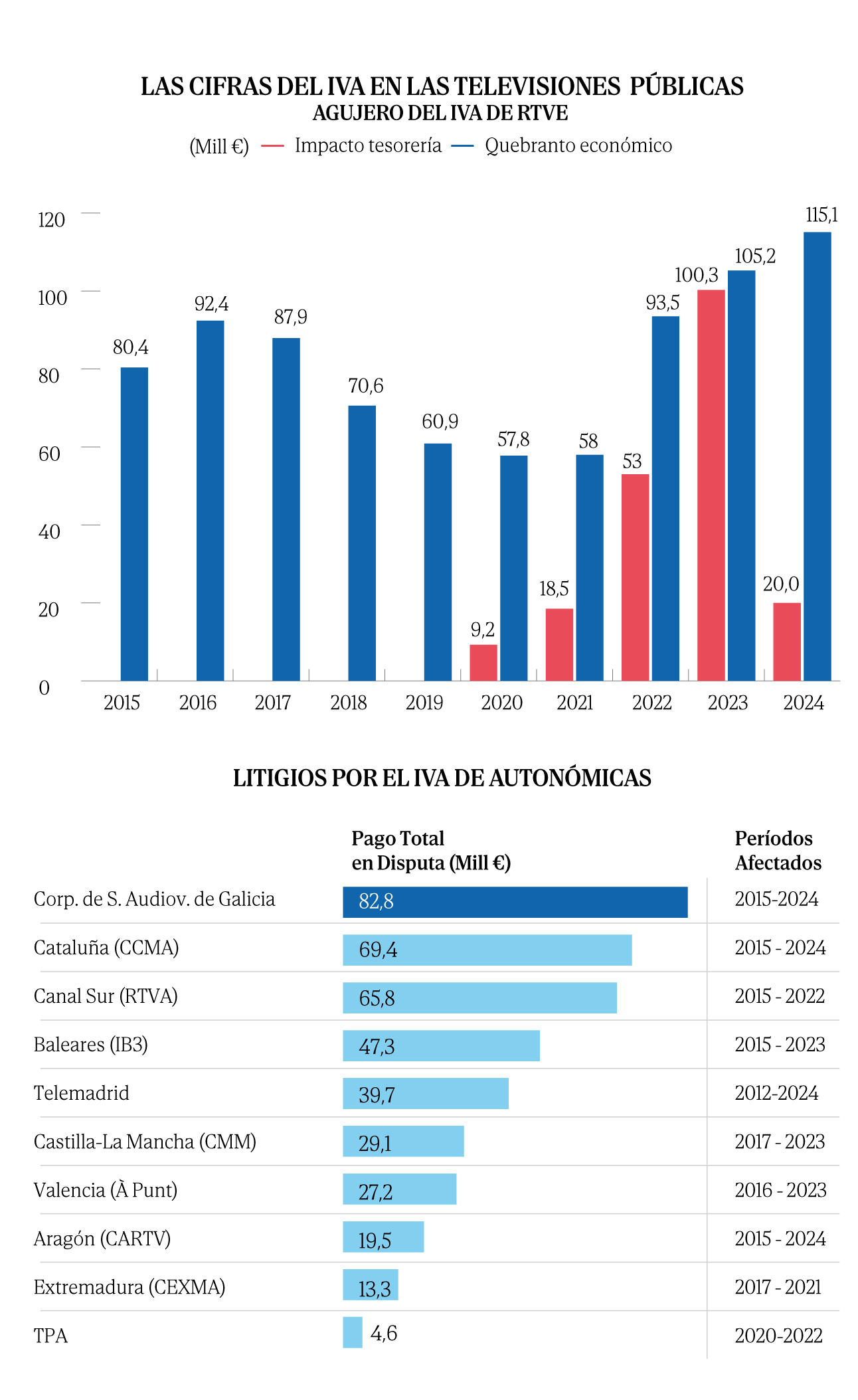
The recent decree by the government has significantly upset the precarious balance between public television broadcasters in Spain. Specifically designed to rescue RTVE from its deep “VAT hole,” the decree exclusively benefits this state entity, handing it distinct advantages over regional channels which continue their long-standing battle with Hacienda over VAT deductions, with more than 400 million euros at stake in ongoing court cases.
A Prolonged Conflict: Hacienda and Public Broadcasters
The conflict between Hacienda and public broadcasters spans over a decade, marked by multiple episodes. Initially, public corporations emerged victorious when the Court of Justice of the European Union ruled that they need not pay taxes on subsidies received to deliver public service. This victory was followed by disputes surrounding VAT deductions, with broadcasters arguing for broad deductions while Hacienda insists on a proportional model, allowing only deductions related to private business activity.
Financial Distress at RTVE
RTVE’s fiscal health has become particularly concerning. An audit of the corporation’s 2024 accounts warned of a potential cash outflow of 200 million euros and an estimated economic shortfall exceeding 800 million euros, as RTVE includes tax contingencies on its balance sheet as future debts owed by the state.
Government Decree: A Safety Net for RTVE
The newly introduced decree establishes a mechanism to ensure that if RTVE loses its legal battles, the state will automatically compensate for the losses, thereby safeguarding its financial health. Contrarily, the decree fails to provide any similar safety net for regional broadcasters, effectively prolonging their legal struggles while guaranteeing a favorable outcome for RTVE alone.
A Call for Unity Among Regional Broadcasters
Industry representatives reflect on the instability created by this situation, complicating competition. A consortium of regional broadcasters, Forta, has yet to publicly comment but is analyzing the implications for its members. This association underscores that full VAT deduction has been a long-standing demand, yet the current situation places RTVE, their primary competitor for audience share, at a distinct advantage.
Varying Tax Relationships
One standout is EITB, the Basque public broadcaster, which maintains a unique fiscal relationship with the Foral Treasury and has not encountered similar taxation conflicts. The Canary Islands also benefit from their own VAT regime without entanglement in the broader legal disputes affecting other regions.
The Role of the Congress of Deputies
The fate of the decree relies on validation by the Congress of Deputies. The government needs support from regionalist partners sensitive to public media health in their communities, making the upcoming discussions crucial.
Judicial Updates: Supreme Court and ECJ
Recent decisions indicate a pivotal point for RTVE concerning its debt relief. Telemadrid faced a setback from the National Court in claiming deductions from 2012 to 2014. Furthermore, the Audiencia Nacional recently referred a prejudicial question to the Court of Justice of the European Union (CJEU), effectively freezing all ongoing litigation on these lines.
Effects on Regional Television
Consequently, several regional broadcasters, including Castilla La Mancha Television and others, have received notices of litigation freezes as they await the CJEU’s ruling, which typically takes about 18 months. This situation prolongs existing disputes while creating financial uncertainties tied to ongoing VAT deductions.
Diverse Accounting Strategies
Regional broadcasters have adopted various strategies in response to ongoing conflicts. The Galician broadcaster holds the largest disputes, reaching approximately 83 million euros but has adjusted its VAT deductions to align with Hacienda’s criteria, shifting from claiming full VAT deductions to a mere fraction. Other regions, like Extremadura, also experienced similar adjustments.
Growing Financial Strains
The ongoing tug-of-war between Hacienda and public broadcasters resembles conflicts among regional channels competing for viewership. RTVE’s budget, funded heavily by state coffers, has been on a continual rise for years. For four consecutive years, RTVE has received over 1 billion euros in subsidies, maintaining a growth trajectory that has consistently exceeded 10% annually.
Audience Wars and Future Implications
The audience competition remains fierce. At a critical juncture in 2021, RTVE’s primary channel almost lost its audience dominance to regional channels. However, since then, RTVE has increased its viewership, and even launched targeted initiatives, such as La2Cat. Although recent moves to capture regional viewership have not significantly boosted numbers, they continue to threaten the balance of competition.
In conclusion, the contest between RTVE and regional broadcasters over tax issues, funding, and programming continues to evolve, spotlighting disparities and invoking calls for strategic unity in a highly competitive and financially complex environment.