
History of Solar Eclipses in Spain
Solar eclipses are fascinating astronomical events that many people have yet to witness. While there are typically between 2 and 5 solar eclipses each year, their visibility is limited to a narrow band of the Earth’s surface. Unlike lunar eclipses, which can be seen by anyone on the nighttime side of the Earth, solar eclipses demand precise timing and location. Statistically, it takes about 300 to 400 years for an eclipse to reappear at the same geographical location. Thus, the occurrence of three solar eclipses from 2026 to 2028 visible from Spain is particularly noteworthy.
The Trio of Eclipses
In the years to come, Spain will witness three solar eclipses, though only one will be total; the final one in 2028 will be annular. While these eclipses will not be visible from the same regions, their rarity cannot be understated. Interestingly, Spain experienced a similar phenomenon between 1900 and 1912, with eclipses occurring in 1900, 1905, and 1912.
May 28, 1900: A Total Solar Eclipse
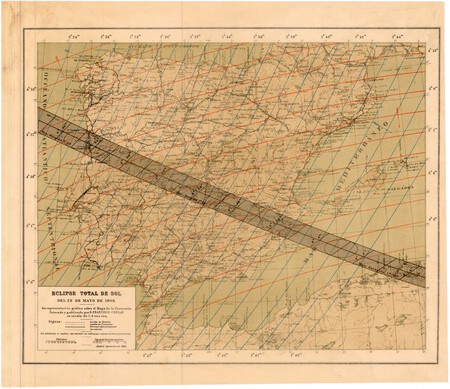
The first eclipse in this trio took place on May 28, 1900, reaching totality at 14:53 UTC. The path of totality measured 70 kilometers wide, traversing from northern Extremadura to Elche. During this period, eclipses still carried a sense of superstition, yet many began to view them as captivating spectacles. As a result, thousands flocked to the path of totality to catch a glimpse.
The strip of totality spanned from the north of Extremadura to Elche
Plasencia and Navalmoral de la Mata in Cáceres were among the most popular spots, with over 4,000 train tickets sold from Madrid to Navalmoral. The demand was so high that ticket prices even rose by 25% once the initial batch sold out. This event attracted not only local spectators but also scientists from Spain, England, France, and Ireland. Noteworthy documentation came from Manuel Gil, a professor at the Central University of Madrid, who captured significant images of the eclipse.
August 30, 1905: An Eclipse of Change
The second solar eclipse occurred on August 30, 1905, starting at 13:03 UTC. Totality was visible in a strip extending from northern Galicia to the northern Valencian Community, crossing through Castilla y León and Aragón. This eclipse was significant in that the apocalyptic fears associated with eclipses were considerably reduced; many were calmer knowing that the world didn’t end in 1900.
The epicenter of this eclipse was Quintanilla in Burgos, and prime viewing locations included Burgos city and Cistierna. Unfortunately, weather conditions hampered visibility in numerous areas. Despite these challenges, this eclipse received great media attention and drew astronomers from across Europe.
April 17, 1912: A Peculiar Mixed Eclipse
The eclipse on April 17, 1912, was notably different as it was a mixed annular-total eclipse. A minuscule strip of totality lasted only a few seconds, while annularity was visible from Porto to Gijón. Unlike total eclipses, annular eclipses don’t result in complete darkness; in these events, the Moon obscures the Sun’s center, leaving a bright ring. Although this eclipse garnered the interest of numerous astronomers, including both Spanish and French scientists, its fleeting nature limited its draw among the general public.
October 2, 1959: The Last Total Eclipse Until Now
The narrative often suggests that the last total solar eclipse in Spain occurred in 1912, but another eclipse took place in the Canary Islands on October 2, 1959. Totality could be witnessed in various locations across Tenerife and Gran Canaria, attracting both national and international attention. Future eclipses promise to bring renewed excitement and exploration of these celestial phenomena.
Looking Ahead: 2026-2028
As the countdown begins for the upcoming trio of solar eclipses, anticipation is building. With one total and two unique eclipses around the corner, Spain will once again become a focal point for astronomers and eclipse chasers alike. The very thought of these upcoming celestial occurrences fills us with wonder and excitement.