
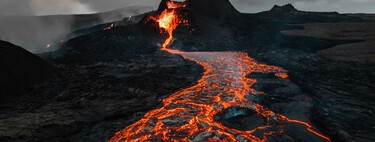
The Tajogaite Volcano: A Giant Steam Iron?
Last Wednesday, while storm Therese unleashed over 117 liters of rain per square meter in the Roque de los Muchachos, something curious occurred just a few kilometers away in the Tajogaite lava flows. The rainwater, upon touching the ground, vanished without forming puddles or flowing away. The explanation? It evaporated instantaneously, effectively transforming the rugged lava field into a massive steam iron.
A Hot Zone: The Ongoing Mystery
While it may seem like the La Palma volcano has reactivated, that is far from the truth: it has been officially dormant since December 13, 2021. Over four years later, the ground below continues to heat up from within.
Why Is This Happening?
To grasp the situation, we must first explore how rocks behave as materials. The basaltic lava that erupted from Tajogaite reached temperatures of up to 1,200 degrees Celsius, nearly double that of other volcanic types like andesitic lava, which hits around 800 degrees. This notable difference in temperature plays a significant role in the cooling process.
However, the crucial factor is not merely the temperature but the fact that rock is a poor heat conductor. Thus, while the outer surface may feel cool and even support vegetation, temperatures at depths of 15 to 20 meters can still exceed 150 degrees Celsius. Hence, when rain falls on this surface, it evaporates almost immediately.
Beneath the Surface: A Geological Puzzle
What we observe during rainy spells is just the tip of a much larger geological iceberg. A study published in 2025 produced the first three-dimensional map of Tajogaite’s internal structure, revealing that beneath the crater lie areas with anomalies indicating the presence of pockets and conduits still filled with magma and gases. This observation does not suggest that another eruption is imminent but highlights that residual volcanic activity may persist for years.
The Inevitable Cooling Process
When will the volcano finally cool down? The most honest answer is that no one can say for sure, as numerous factors come into play. These include the thickness of the lava flow at different locations, the rock’s porosity, and the ambient temperature. Consequently, each area reveals its unique story in this cooling saga.
What is clear, however, is that the subsoil will gradually cool, and the dramatic scenes witnessed during recent storms should diminish over time. Eventually, this cooling process will yield a completely new land formation in Spain, a landscape that will continue to evolve and mature.
Images credited to Annamarie Ursula and RTVC.
Related article: In Xataka – Under the Canary Islands rests a 1,625 meter volcano showing signs of life after a decade of dormancy.