
The Stellantis Puretech Engines Scandal: A Deep Dive
The Stellantis Puretech engines scandal continues to send shockwaves through the automotive industry. This is no small matter; it affects hundreds of thousands of vehicles within the automobile group, leading to breakdowns and legal challenges that have deeply tarnished the company’s reputation. It’s crucial to note that the wet timing belt technology at the center of Stellantis’s controversies is not exclusive to them. Both Ford and Volkswagen have also utilized this contentious technology, albeit with varying repercussions in their operations.
The Promise of Revolutionary Technology
The saga began with what seemed like a brilliant innovation : to eliminate the costly maintenance associated with traditional timing belts by developing a system designed to last the entire lifespan of a vehicle. This inventive solution involved a timing belt bathed in oil, which engineers touted would reduce friction and extend durability to 240,000 kilometers . The intention was that the oil would enhance the rubber’s elasticity, protecting it from wear and tear.
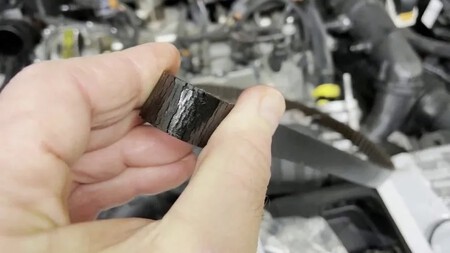
Status of the distribution strap of a Peugeot 3008 after 40,000 km. Image: OGS Mechanics
Ford: A Pioneering Response
The American automotive giant Ford was the first to adopt this wet belt technology, even prior to the launch of its EcoBoost engines . The method involved integrating the system inside the engine instead of utilizing a traditional side housing. However, when issues began to arise, Ford acted swiftly to mitigate damage. Rather than allowing a full-blown scandal to unfold, the company replaced the wet belt with a chain in its three-cylinder EcoBoost engines where deactivation was an option, averting a potential crisis.
Volkswagen’s Cautious Approach
Like Ford, Volkswagen also embraced the wet belt, specifically in its diesel engines such as the 1.6 TDI and the 2.0 TDI. However, Volkswagen employed a less risky strategy , as the wet belt only managed the oil pump rather than driving the camshafts. This vital technical distinction explains why Volkswagen has largely escaped the catastrophic consequences that have plagued Stellantis.
Understanding the System Failure
The core issue at hand was that Stellantis made the wet belt the critical component of the entire distribution system, directly responsible for synchronizing the valve train. A failure here results in catastrophic outcomes, often leading to thousands of euros in repairs and potentially rendering the engine entirely inoperable. In contrast, both Ford and Volkswagen limited the wet belt’s functions to less crucial operations, which allowed them to respond proactively when potential failures were detected.
Real-World Implications of the Scandal
The failure of the wet belt mechanism became increasingly apparent, particularly in three-cylinder engines frequently used in urban settings. Here, unburned fuel mixed with crankcase oil creates an abrasive mixture that tends to degrade the belt prematurely. This damaging blend can obstruct filters and ducts, ultimately leading to insufficient oil pressure. Delaying the fault detection process can be disastrous, and Stellantis’s optimism in integrating this technology only exacerbated the issue.
The fallout was significant for Stellantis. Hundreds of thousands of vehicles equipped with 1.0 and 1.2 Puretech engines manufactured between 2012 and 2023 were called in for review. The company has faced mounting pressure to extend warranties, create reimbursement systems, and even change leadership, with Antonio Filosa stepping in as CEO after the dismissal of Carlos Tavares.
Identifying Affected Vehicles
If you are uncertain whether your vehicle is equipped with a chain or the problematic wet belt, you can verify through the engine code. The 1.2 Puretech engines with a chain have designations like “EB2LTED” or “EB2LTEDH2” and can be found in models such as the Peugeot 408 , Opel Frontera , and Fiat 600 .
The problematic engines primarily affect the Citroën C3 , C4 , Peugeot 208 , 308 , 3008 , Opel Corsa , Mokka , and DS 3 and DS 7 manufactured during the same timeframe. Stellantis has extended warranties and offers reimbursements for repairs, making it crucial for affected users to act promptly to detect faults and take necessary action.
In conclusion, the Stellantis Puretech engines scandal serves as a cautionary tale in automotive engineering, highlighting the potential risks associated with innovative technologies when not approached with due diligence.