
The Shadow Economy: A Closer Look at the Dark Side of Global Finances
It is often said that each person can spend their money as they wish. However, the forthcoming question is whether everyone will be able to pay as desired in the future . Cash remains a crucial part of daily transactions, leading to an unequal race across the globe and a pressing issue: the shadow economy , which contributes significantly to the GDP of many nations.
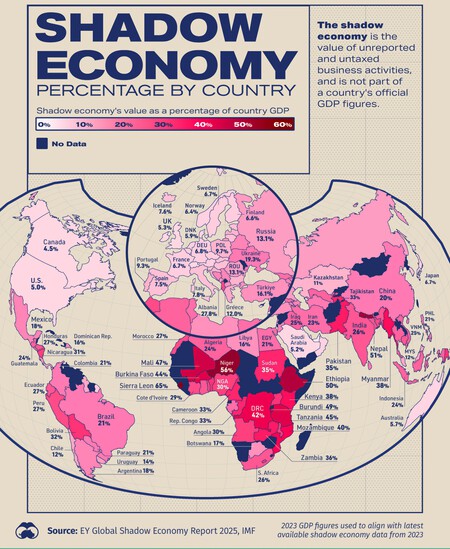
This map created by Visual Capitalist perfectly illustrates this concept, although it’s essential to recognize that the cited percentages can be deceptive.
In the Shadows. Certain countries are waging a war against cash, pushing for digital payments and tools like the Digital Euro. The map is based on the 2025 Global Shadow Economy Report by Ernst & Young. It reflects the proportion of each country’s GDP that evaded fiscal control in 2023.
Complexity in Measurement. While this informal economy represents a substantial loss of fiscal revenues for governments, pinpointing an accurate figure remains challenging. This arises because these are economic activities that are neither declared nor regulated.
Activities like cash payments that bypass VAT, undeclared jobs, informal rentals, or seemingly innocuous private tutoring sessions that don’t issue invoices fall under this umbrella. Depending on the study, various GDP percentages are cited by country; however, one constant remains: the disparity between hemispheres.
The Northern Hemisphere. Globally, the shadow economy is estimated to account for 11.8% of GDP. Although exceptions exist, there is a clear divide between the northern and southern parts of the world when it comes to this percentage of GDP associated with shadow economy funds.
In Europe, countries like Poland , Spain , Portugal , Italy , and Greece exhibit higher levels of shadow economy activity. Greece, Romania, and Ukraine elevate this average, with Albania boasting over 27% of its economy linked to the shadow sector.
Meanwhile, Canada and the U.S. remain lower at 4.5% and 5% , respectively, while Saudi Arabia records 5.2% . Japan follows at 6.7% , Mexico reaches 18% , and Central America witnesses increasing shadow economy levels.
The Southern Hemisphere. Australia, at 5.7% , is an exception among southern hemisphere countries, where the shadow economy usually runs rampant. Latin America also experiences high shadow economy levels, but these figures pale in comparison to those seen in Africa and certain Asian nations.
Africa leads in this area, with estimates indicating that if Sierra Leone had a GDP of $6.4 billion in 2023, an additional $4.1 billion —or 64.5% —was part of its shadow economy. This isn’t an isolated incident; countries like Nigeria , Ethiopia , and Burundi also report shadow economies equivalent to 50% or more of their GDP.
In Asia. The situation in Asia isn’t as dire, although it isn’t the most transparent region financially. The shadow economy in India is roughly 26% of its GDP, while in Iran and Iraq , it is similar. In Nepal , it climbs to 51% , and China stands at 20% .
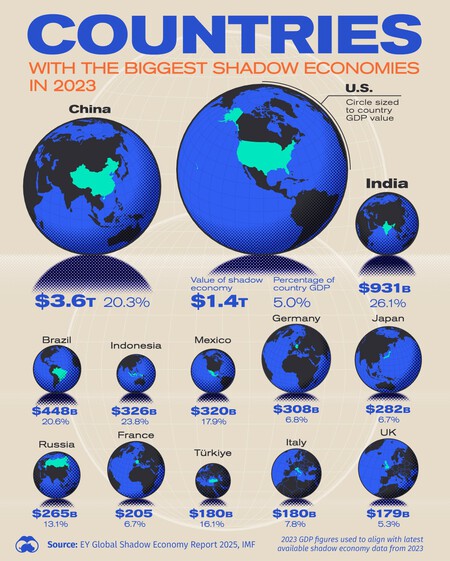
While these percentages may seem lower than those in many African countries, the sheer population involved results in substantial amounts. For instance, India’s 26% might appear minimal compared to nations with higher rates, yet it translates to significantly larger figures.
Misleading Percentages. It’s crucial to recognize that the 64.5% of Sierra Leone’s GDP does not equate to the 5% of the U.S. A larger economy, even with a smaller shadow economy percentage, can lead to astronomical sums overall.
In this additional chart, the disparity becomes clear: 20% of China translates to €3.3 trillion , while the United States, with its relatively minor 5% , boasts the largest shadow economy on the planet, totaling approximately €1.3 trillion .
The Security of Cash. As mentioned earlier, some countries are attempting to combat this shadow economy. For instance, Portugal has transformed bills into lottery tickets, allowing for oversight without labeling all unreported activities as illegal, aiming for increased tax revenues.
Utilizing cards or digital means may appear to be a solution, although concerns arise regarding functionality in the absence of internet or electricity. The recent blackout in April showcased that POS terminals were prepared for such challenges, indicating that the potential future Digital Euro is also equipped for this.
If it arrives at all someday.