
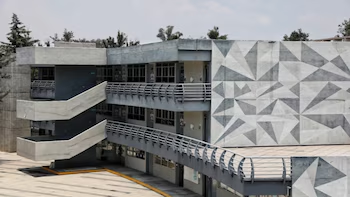
Expansion of Higher Education Access in Mexico
The Government of Mexico has launched an ambitious plan to transform access to higher education, with the Rosario Castellanos National University (UNRC) at its forefront. Under the leadership of Secretary of Public Education Mario Delgado Carrillo, the initiative aims to increase university enrollment significantly over the next few years.
Projected Enrollment Growth
According to projections, university enrollment is set to grow from 77,025 students in 2025 to 202,456 by 2030. This increase aligns with commitment number 32 of the hundred laid out by President Claudia Sheinbaum Pardo. This initiative addresses the growing demand for higher education in Mexico and represents a critical step towards inclusivity in educational access.
Current Structure of UNRC
Currently, UNRC operates across nine campuses located in various regions, including:
- Tijuana (Baja California)
- Soledad de Graciano Sánchez (San Luis Potosi)
- Naucalpan
- Chalco
- Chimalhuacán (State of Mexico)
- Mexico City
- Teolocholco (Tlaxcala)
- Comitán (Chiapas)
- Kanasin (Yucatán)
With 1,721 teachers, these campuses provide a solid educational foundation to a diverse student community.
Inclusive Educational Commitment
The granted institutional network consolidates a robust commitment to offering inclusive and quality higher education, focusing on responding to the evolving demands for professional training and research in Mexico.
UNRC provides an academic offering that includes:
- 36 Bachelor’s degrees
- 5 Specialties
- 3 Doctorates
- 15 Postgraduate degrees
- 7 Master’s degrees
This variety aims to equip students with ample opportunities for high-level academic development, ensuring they are well-prepared for the job market.
New Developments in Michoacán
In a bid to further expand access to education, Secretary Delgado Carrillo announced the construction of five new UNRC headquarters in Michoacán. This move aims to facilitate university education for local youth, preventing the need for them to travel out of state. These new facilities are expected to benefit 8,000 Michoacán students, aligning educational programs with regional productive vocations.
Enhancing Educational Coverage in Michoacán
As part of the Michoacán Plan for Peace and Justice, there is a push to increase higher education coverage in the state by 45% by 2027. This effort includes creating 50,000 new spaces in higher education institutions. Collaborative actions are being undertaken with key educational providers, including:
- National Autonomous University of Mexico
- Michoacán University of San Nicolás de Hidalgo
- 17 National Technological Institutes
- Intercultural, Technological, and Polytechnic Universities
- National Pedagogical University
- Secretariat of Science, Humanities, Technology, and Innovation (Secihti)
National Objectives
Delgado Carrillo emphasized that all initiatives in Michoacán are part of a broader national strategy sponsored by the presidency. The ultimate goal is to achieve 55% coverage in higher education by 2030, which translates into the creation of approximately one million new spaces. This strategic vision is pivotal in fostering a well-educated population, positioning Mexico for future economic and social advancements.