
Can you walk a block of stone the size of a school bus? Can a rock that weighs tons and measures several meters long be “walked”? The most logical answer is (obviously) no, but things change when we talk about the moai of Easter Island, the unmistakable carvings that adorn this remote Polynesian island. These monumental sculptures were created centuries ago by the Rapa Nui people.
Beyond their meaning and characteristics, archaeologists have always wondered how the inhabitants managed to move those multi-ton statues from the quarries to the ahu , the ceremonial platforms where they stand. Surprisingly, the answer is not just literal—it involves the idea of “walking.”
An Ancient Mystery
There are few sculptures in the world as iconic and fascinating as the moai of Easter Island. These enormous rock heads give rise to countless questions since the arrival of Jacob Roggeveen and his crew in 1722. What was their purpose? What do they represent? And perhaps most intriguingly, how did the Rapa Nui people move these colossal statues from quarries to their ceremonial settings?
Why is this so surprising ? Because the statues, carved from volcanic tuff at Rano Raraku, can weigh tons and measure several meters long. On average, they stand about 4.5 meters tall and weigh around 10 tons . Considering the engineering feats involved, the question remains: how did the islanders move them?
Much research and speculation have surrounded this topic, leading to various theories. One popular idea suggested that the moai were laid down on wooden sleds with ropes. However, recent studies indicate that these massive statues could have been moved by a method that may seem far-fetched: they “walked.”
‘Walking’ Sculptures
The ancient legends of Rapa Nui claimed that the moai arrived at their ceremonial platforms “walking.” While this idea was once dismissed as folklore, recent research has validated elements of this narrative. A study combining physics, 3D modeling, and field experiments, led by researchers from Binghamton and Arizona universities, has concluded that “the statues really walked.” Excitingly, this movement was governed by simple physics and engineering principles.
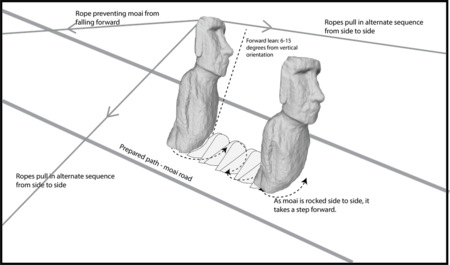
All that was required were ropes , people , dedicated paths , and smart design . Professor Carl Lipo and his colleague, Terry Hunt, studied nearly a thousand moai. They proposed that the Rapa Nui inhabitants used ropes to create a zigzag pattern as they moved the statues along carefully crafted pathways.
Is this theory new? Not entirely. In the 1980s, a Czech engineer suggested the moai could be moved upright using two-points of leverage. Lipo and his colleagues have long advocated that the statues could “walk” utilizing vertical and oscillating movements, challenging older theories that suggested they were transported upside down with logs. To validate their claims, they even conducted practical demonstrations that gained the interest of National Geographic .
The more recent research aims to settle ongoing debates by using modern technology.
From Theory to Practice
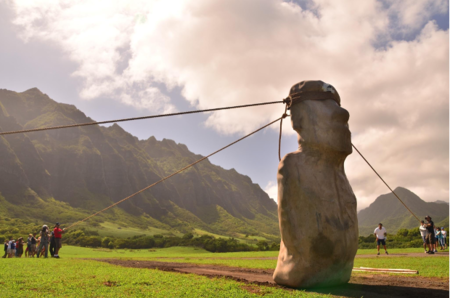
To prove the validity of their theories, Lipo and his team engaged in meticulous analysis, employing high-resolution 3D models to study the various moai forms—both upright and toppled. In addition to theoretical evaluations, they constructed a 4.35-ton moai and utilized ropes to move it. This simulation revealed that with just 18 people , they could transport the statue 100 meters in 40 minutes . “Once it gets moving, it’s not difficult. People pull with one arm, saving energy and moving quickly,” Lipo noted. The primary challenge lies in initiating movement.
This practical experiment, along with the 3D analysis, stands to substantiate their claims in the archaeological community, as articulated in a recent study released in the Journal of Archaeological Science titled “The Hypothesis of the Walking Moai.”
Furthermore, the researchers identified certain unique characteristics in the moai’s designs, such as “wide ‘D’ shaped bases” and a forward inclination of 5 to 15 degrees . Such features potentially facilitated their movement in a zigzag pattern utilizing the ropes. Upon reaching their final destination, the statues were then finished to stabilize them.
Lastly, the paths created by the Rapa Nui people, approximately 4.5 meters wide with a concave cross-section, seem designed to stabilize the moai during transportation. “It looks like every time they moved one, they were building a road,” Lipo reflects.
According to Lipo and his colleagues, these revelations not only provide a plausible explanation for how the moai were moved but also celebrate the ingenuity of the Rapa Nui people. “It shows that the people of Rapa Nui were incredibly intelligent.” Their research stands as a testament to the melding of tradition and science in understanding monumental achievements.