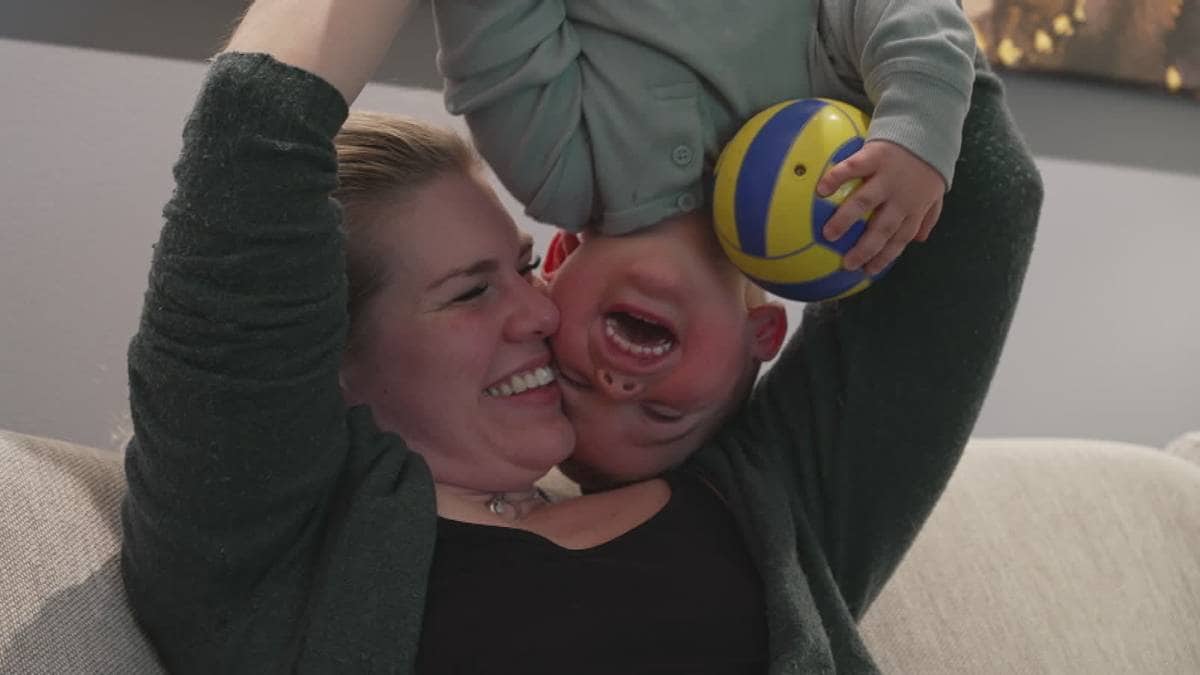
– We are used to stares, but we were before we had children too. Lena Schrøder (31) is the proud mother of a healthy and fast two-year-old. She is a doctor, she has been selected as an astronaut candidate, and she has written Norwegian sports history. Nevertheless, she is well used to prejudice. – You see that people think a lot about: “Is that your child?”. Schrøder and her fiancé Morten Værnes, who is also a top athlete, are not quite like other parents of young children. Both are in wheelchairs. – One thing is when you come alone in a wheelchair, you get some stares because you stand out. And when two people arrive in wheelchairs together, it stands out even more. And when you come with two people in a wheelchair plus a pram, many people are a little confused, explains Schrøder with a smile. TRIO: Schrøder and Værnes on their way from kindergarten with their son Alex. Photo: Kai Rune Kvitstein / news I think people will be surprised “You’re going to come home, aren’t you?” “No lunch box?” “That’s the one standing there, yes?” The daycare pick-up sounds like any daycare pick-up, but it looks a little different. – How does everyday life work for you, two people who sit in a wheelchair and play parahockey and have a son? – It’s actually going very well. There were some challenges at the very beginning, but now it’s really just automatic. Our son doesn’t know much else, so he’s used to both being in wheelchairs. LOVE: Schrøder and the two-year-old snuggle after kindergarten. Photo: Susann Michaelsen / news But for those around them, the trio is still an eye-catcher. – I think people are a bit surprised, explains Schrøder, and tells of an episode with health personnel when Alex was a newborn and they were still in hospital. – She was probably just a little unaware of how this would go, and how we were going to handle it, and if we didn’t have any help. But I think we managed to calm her down pretty quickly. The couple had to undergo test-tube treatment to become parents, and Schrøder in particular was prepared to face opposition in the health care system. – So, they would have had the opportunity to put a stop to it if they thought that this was completely unjustifiable. No one has done that. It may very well have been discussed behind the scenes, but during the whole process it was never a case that we both used wheelchairs. – We knew it was going to be like this. Two-year-old Alex is running with a small hockey stick. The two adults participate in their own wheelchairs. They lift him in the air, turn him upside down, everyone laughs. HOCKEY FEVER: The son also loves hockey. Photo: Susann Michaelsen / news Schrøder is clear that she has never let her disability prevent her from living the life she wants. – Rather, it has made me want to refute people. And a little myself, I think. That I have felt a need to show what I can do. Which means that I have worked extra hard towards what I want to achieve, in sports, in education, work and other things. And there was never any doubt that she would become a mother. – It has just been a matter of course for us that we will have children, says Schrøder, and continues: – We know that the reality is that we both use chairs. We wanted to have children. We knew it was going to be like this and like that, and so we have taken the challenges as they have come. She gets support from her partner: – There will be some challenges when we are both in wheelchairs. I think that we can manage most things in one way or another, says Værnes. – Persistent through thick and thin Schrøder does not hide that there have been some challenges, especially when his son could not sit or lie without support, but now he runs and climbs onto his lap. In addition, both parents benefit from the fact that they are very strong in the upper body. It comes, among other things, from a content-rich sports career. Værnes is a national team player in parahockey. Schrøder also has many years behind her on the men’s national team in the same sport, and she made history when in 2018 she was the only woman in the entire Paralympics who took part in para hockey. HISTORICAL: Schrøder played on Norway’s men’s team during the Paralympics in 2018. NATIONAL TEAM TRAINING: Schrøder in action in 2024. NATIONAL TEAM TRAINING: Schrøder in action in 2024. – I had to work a lot and very hard for it. It took its toll, explains Schrøder, who had to be on par with the men to get a place on the team. Now she is part of Norway’s women’s national team in parahockey, which is in the establishment phase. – I am very excited to achieve that. We are missing a few players. Hockey has played an important role in the 31-year-old’s life. She was born with spina bifida, and her paralysis came on gradually. Then the parahockey environment was a refuge from the feeling that she was different. LIFE SMILES: Schrøder is satisfied with life. Photo: Susann Michaelsen / news – I came into an environment where it was completely normal to have paralysis and use a wheelchair. Nothing stood out, and it was very nice to feel as a 15-year-old. Today, she is grateful for what sport has given her. – I think a lot of what I have been able to experience is thanks to sport. She recalls the meeting with her partner, various positions, an active environment and good friends. – I’m probably quite stubborn, and that has helped me a lot. But I might not have stood as hard on the demands if I hadn’t had to fight a little for what I need and want, she says firmly. The roommate agrees: – She is stubborn about good and bad. Mostly good. Once she sets a goal, she accomplishes it. And finish all the way in, no matter what it is, whether it’s hockey or work or up in space. Because now another door has been opened for Schrøder. “What have I agreed to now?” In 2022, the 31-year-old was recruited into Nåva Space, where she was asked if she wanted to become an astronaut candidate. The Norwegian company collaborates with Space X, among others, and will research what the weightless state does to the brains of astronauts. They will also perform surgical interventions in space. – I agreed to that right away, without really knowing much about it. The idea is that we will try to get the first astronaut with a disability into space, she explains, and adds: – If everything goes according to plan, and I am medically approved, then the plan is for me to become part of the first crew to Nåva Space. PRE-PROTOTYPE: Shahinian shows off a prototype of a prototype of a space suit. Photo: Kai Rune Kvitstein / news The question came when she was pregnant. Then she was unprepared for how the strong maternal feelings would affect her. – I started to maximize the crisis a little. I thought “what have I agreed to now? What if something happens, what if he becomes motherless?”. Schrøder has had many rounds with herself, and each time the conclusion is the same: She must leave. – And I don’t think I could live with myself if I had said no. Nima Shahinian, the man behind the project, is aware that there are many reasons why Schrøder was chosen. – It is the combination of the fact that she is a trained doctor, her mentality, and then she has explosive, enormous strength in her upper body. The strength makes us believe that in the event of an emergency landing, she will be able to get herself out of a capsule, explains Shahinian. He emphasizes the 31-year-old’s medical education: – Yes, Lena is a doctor, so it is clear that she contributes greatly to being a doctor during this medical procedure. It may well be that the medical procedure will actually be done on Lena as well, he admits. The space adventure joins the series of positive elements in Schrøder’s life. She believes her disability is responsible for much of the good in life. – I wouldn’t have been able to experience all the things I’ve experienced, if it hadn’t been for the fact that I used a wheelchair. HISTORICAL: Schrøder was the only female sled hockey athlete in the Paralympics in 2018.
ttn-69