
Price Complaints Reflect Deeper Issues in Spain’s Labor Market
Every shopping trip brings with it the familiar complaints of rising grocery prices, from fruit to essential proteins like salmon. These grievances are no longer just local murmurs; they now resonate on a global scale, as articulated in the recent OECD Employment Outlook 2026 report.
Low Wages: Spain’s Continued Challenge
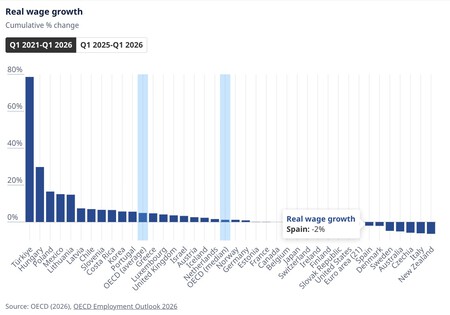
The OECD report shines a light on the complexities of Spain’s labor market, acknowledging improvements like increased employment and reduced temporary contracts. Yet, it drives home a crucial point: low wages continue to plague Spanish workers. According to the report, real wages in Spain remain 2% below their 2021 levels, marking a significant stagnation in purchasing power. This decline puts Spain among the countries experiencing the highest decreases in purchasing power since the pandemic, trailing just behind Italy and Australia.
Disparities in Salary Evolution
The disparity in salary evolution over recent years is striking. While the minimum wage has seen a substantial increase—reaching 1,221 euros per month in 2026, marking over a 60% rise since 2018—other salaries have barely budged. This widening gap forces experienced employees to earn only slightly more than those entering the workforce, threatening the very fabric of wage fair play.
Increase in real wages according to the OECD. Spain in the tail group
Understanding the Math Behind Wage Stagnation
Recent INE data indicate that labor costs per worker increased 4.9% in the first quarter of 2026. However, with inflation hovering around 3%, the real purchasing power for many workers remains nearly unchanged. Despite a 2% growth in real wages last year, they still fall short of pre-pandemic levels, indicating persistent wage stagnation in Spain.
The Productivity Puzzle
Why this stagnation? The OECD points to a lack of productivity growth as the central issue. With just marginal improvements over the past decade, companies feel pressured to keep salary increases minimal. The report warns that unless productivity measures improve, real wages will likely remain stagnant through 2026 and 2027.
Some Positive Developments
Despite these issues, some positive trends are emerging. Companies appear less reactive during economic downturns, with layoffs decreasing from 8.9% in late 2019 to 4.3% in early 2026. The 2022 labor reform aimed at encouraging permanent contracts is credited as a driving factor, leading to a significant drop in temporary contracts from 24.8% to 14.8%.
Unemployment: An Ongoing Concern
Another burden highlighted by the OECD is Spain’s high unemployment rate, which remains the second highest in the OECD, only slightly lower than Finland. As of May 2026, the unemployment rate has improved to 10.3%, reaching levels akin to those seen in 2007. Yet, this improvement masks geographical disparities, with job availability varying significantly between regions.
Conclusion
The OECD’s findings illustrate a complex landscape for the Spanish labor market—a blend of progress and significant challenges. To fully recover and advance, a focus on productivity and equitable wage growth is essential, as reliance on minimal wage increases alone is proving insufficient. Without a holistic approach to these economic concerns, the struggles of everyday Spanish workers are likely to persist.

Finding a job had always been a good way to escape poverty: in Spain, it is no longer true