

The Revolutionary Contributions of John Napier to Mathematics
The name John Napier might not ring a bell for many, but his legacy in the field of mathematics is monumental. He is best known for introducing the concept of natural logarithms, a tool that many students find daunting during their school years. Napier defined this function in a groundbreaking way, and to “balance” this complexity, he also created what can be regarded as a precursor to the modern calculator.
His invention, known as ‘Napier’s Bones,’ resembles a form of a domino but served to facilitate mathematical operations for a broader audience.
Early Life and Interests
John Napier was a Scottish nobleman with a penchant for various disciplines. He attended the University of St. Andrews at the age of 13 but soon ventured to pursue studies in France, Italy, and Flanders. His life was spent in different castles, where he enthusiastically engaged in numerous intellectual pursuits.
Innovator or Sorcerer?
In his community, Napier was viewed as a Protestant but was often labeled a black magician. He was known for his ingenuity; for instance, when pigeons were eating his grains, he devised a unique method to capture them by soaking seeds in alcohol to effectively incapacitate the birds. While such anecdotes may be embellished with time, they highlight his problem-solving abilities.
Logarithms and Beyond
Napier’s most significant contribution to mathematics is undoubtedly his work titled Mirifici Logarithmorum Canonis Descriptio, where he defined logarithms in 1614. Throughout his life, he published several treatises aimed at simplifying complex calculations, propelling the use of the decimal point and even creating practical tools for resolving mathematical problems.
Introducing Napier’s Bones
As humanity sought to resolve mathematical challenges, various tools emerged. This journey culminated in Napier’s invention, described as a ‘manual tool’ designed to facilitate division, multiplication, and even square roots.
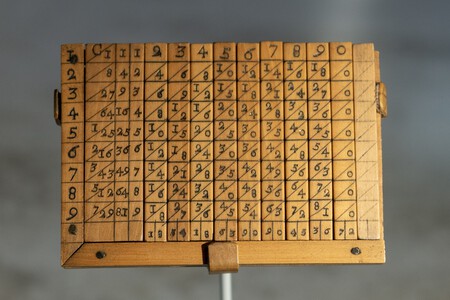
In 1617, shortly before his death, Napier created this remarkable tool comprising rectangular rods engraved with multiplication tables. Each set included a board with slots for these rods, where numbers from 1 to 9 were arranged vertically on the left side.
The Mechanics of Napier’s Bones
Taking multiplication as an example, using these rods meant students didn’t have to memorize the multiplication tables. For instance, to find the result of 2 x 6, one could simply locate row 2 on the right and the rod beginning with 6, revealing 12 in the corresponding cell. Similarly, for 8 x 8, the method would yield 64.
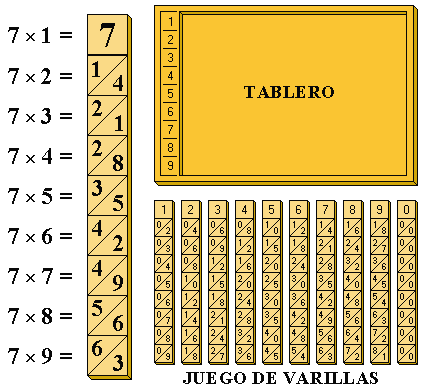
For more complex problems, such as 46785399 x 7, the corresponding rods would be aligned left to right based on each digit. Following this, observing row 7 would reveal the answer.
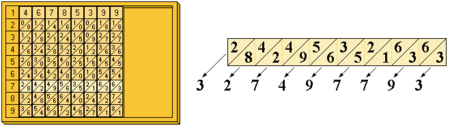
The numbers gathered diagonally from right to left would produce 327497793, the output of the multiplication. Although subsequent mathematicians improved upon this system by introducing an angled board for better visibility, Napier’s Bones made complex calculations accessible to those without formal education.
A Lasting Legacy
John Napier passed away in 1617, likely unaware of the profound impact his work would have on future generations. Today, his logarithmic foundations remain crucial, assisting in various calculations and innovations. His contributions, including the decimal point system and the revolutionary Napier’s Bones, are showcased in prestigious institutions, such as the Museum of Archaeology in Madrid.
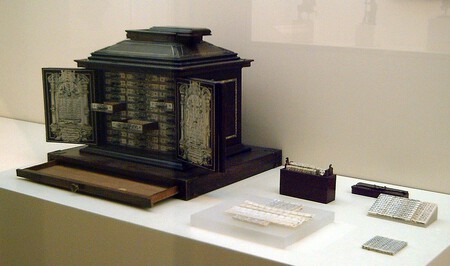
These pieces illustrate not just utility but also the beauty of mathematical tools, reminding us that even devices designed for calculation can be seen as works of art in their own right.