
Electric Consumption: A Global Indicator of Economic and Social Trends
Electric consumption serves as a significant thermometer for countries worldwide. The amount of energy consumed not only reflects economic dynamics but also societal values, climate policies, and technological advancements. Various factors influence this consumption, and a recent graph created by Visual Capitalist highlights the 15 nations with the highest GDP that also consume the most electricity per capita.
The standout in this list is undeniably Canada .
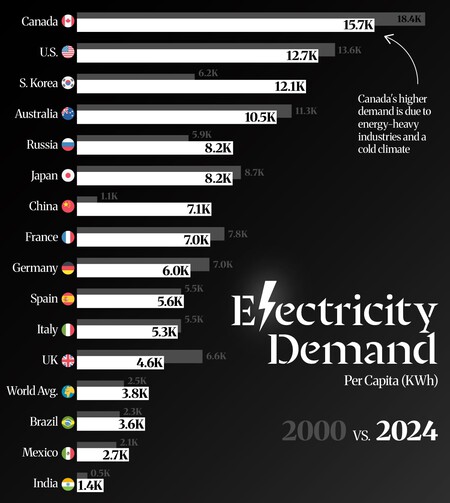
The data sourced from Ember illustrates differences in per capita electricity consumption across major economies in 2024 compared to their stats from 2000. Over a span of 24 years , a considerable transformation is noticeable, although the top two contenders remain unchanged.
Canada leads the pack with a reported consumption of 15,708 kWh per person in 2024, a notable decline from the figures recorded two decades ago. This significant amount stems largely from an energy-intensive industry , particularly mining and aluminum production, coupled with the electricity demands posed by their cold climate. The United States follows closely with consumption figures of 12,741 kWh , driven by similar industrial needs and the heavy reliance on air conditioning for extreme temperatures during both winter and summer.
Next in line are South Korea and China . Australia has traditionally exceeded 10,000 kWh per person, but recent trends show a remarkable surge in South Korea’s consumption—from 6,200 kWh to 12,100 kWh . This increase signifies a robust industrialization phase focused on sectors like semiconductors and automotive manufacturing, combined with a boom in data centers .
China has witnessed a similar trajectory, with per capita consumption rising from 1,100 kWh in 2000 to around 7,100 kWh today. This trend can also be attributed to rapid industrial growth, encompassing industries such as steel , aluminum , electronics , and electric vehicles. It is essential to note that while China’s per capita consumption remains significantly lower than Canada’s, the sheer scale of its population—approximately 1.4 billion —compares dramatically against Canada’s 40 million , representing 17% of the world’s population versus just 0.5% .
This increase in consumption in both South Korea and China isn’t solely rooted in industrialization. Japan, which has a similarly robust industrial base, has seen its electricity consumption stagnate over the years. A compelling factor contributing to rising usage in China is the expanding middle class and an accompanying increase in living standards. Urbanization and electrification of homes have further elevated the demand for electricity.
The migration to urban centers has sparked a construction boom, leading to heightened electrification given the increasing use of appliances and services, paired with a growing reliance on electric vehicles. However, this surge in demand raises challenges, including urban lifestyle trends that complicate family formations and labor shortages in industries—a concern shared with neighboring Japan and South Korea.

Despite the focus on these leading economies, two noteworthy mentions stand out outside the primary rankings: Iceland and Norway . Iceland has an exceptional per capita consumption of 51,920 kWh . This staggering figure is largely due to its small population of roughly 300,000 people living in an environment characterized by limited daylight hours and a demanding climate requiring extensive heating and lighting.
In Norway, with a per capita consumption of 24,580 kWh , factors such as substantial industry growth and a high standard of living contribute to energy demands. An impressive aspect of Norwegian consumption is its electric vehicle market, where close to 90% of new cars sold in 2024 were entirely electric, influencing both home and public charging infrastructure.