
Understanding the Expanding Universe
We have known for a long time that the Universe is expanding. However, the speed at which it does so often confounds scientists. Depending on the method used to measure this expansion, different results emerge. A recent advancement in measurement techniques has yielded a more precise estimate, but instead of resolving the discrepancies, it complicates the situation even further.
An Overlay of Techniques
An international team of scientists has achieved the most precise calculation of the Universe’s expansion speed to date: 73.5 ± 0.81 kilometers per second per megaparsec. This figure aligns well with previous calculations derived from the nearby Universe. However, it diverges significantly from values obtained from the cosmic microwave background (CMB) data, which represents the Universe’s earliest light from the Big Bang. This discrepancy indicates that our understanding of the physics governing the most distant reaches of the cosmos is lacking, intensifying the mystery instead of resolving it.
A Balloon That Inflates
When discussing the Universe’s expansion, it’s essential to recognize that galaxies are becoming increasingly distant—not because they are moving through space, but because the very fabric of space itself is expanding. Visualize this as a balloon with dots painted on its surface; as the balloon inflates, the dots move farther apart, even though their positions remain unchanged.
Hubble Tension Explained
Traditionally, the expansion rate of the Universe is calculated using two primary methods: measuring distances between stars and galaxies in the nearby cosmos or analyzing the cosmic microwave background radiation from the early Universe. Ideally, both methods should yield the same results.
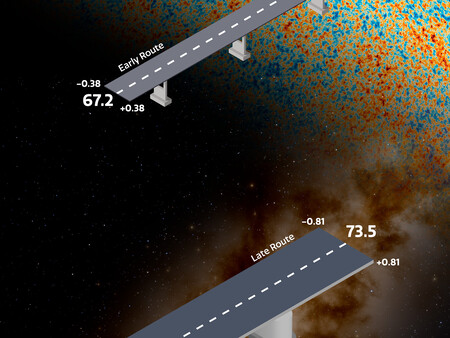
However, calculations from the nearby Universe yield a speed of 73 kilometers per second per megaparsec, while those from the ancient Universe suggest a rate of 67 kilometers per second per megaparsec. This inconsistency, referred to as Hubble tension, implies that the Universe is not just expanding but is accelerating in its expansion.
This graph illustrates the tension between measurements of the expansion rate of the late and nearby Universe versus predictions based on observations of the early Universe, specifically the cosmic microwave background.
It Could Be a Measurement Error
One hypothesis attributes the Hubble tension to potential errors in measuring the expansion rate of the nearby Universe. Multiple methods exist to gauge distances between celestial bodies, which could lead to discrepancies. As a response, an international team has employed a combination of techniques to sharpen their calculations.
Different Types of Stars
This methodology involves analyzing extensive datasets from both ground-based and space telescopes, focusing on stars like Cepheids, red giants, and supernovae that possess characteristic brightness levels. These luminosity traits allow astronomers to map the Universe more accurately. The refined figure of 73.5 ± 0.81 kilometers per second per megaparsec was achieved with this layered approach.
There is No Mistake
Interestingly, the elimination of one measurement technique minimally affected the expansion rate result, indicating that the calculations are robust and free from error. If the Hubble tension isn’t due to inaccuracies in measurement, then what accounts for it?
The Mystery Continues
Despite these findings, the Hubble tension persists as a significant enigma. Researchers theorize that dark matter might be influencing the differing values for the distant and nearby Universe. Additionally, some speculate that Earth resides in a spatial anomaly, akin to a bubble within a cake, where the surrounding matter’s density creates unique gravitational effects.
As noted by scientist Indranil Banik, “the density of matter is greater around the bubble, so gravitational forces emanate from this surrounding matter, attracting the galaxies in the bubble toward the edges of the cavity.” This anomalous positioning may explain why galaxies are receding from us more quickly than expected.
In conclusion, while we may better understand certain facets of the Universe’s expansion, significant questions remain. The Hubble tension is indeed a reality, and tackling its complexities holds the potential to deepen our grasp of cosmic mechanics.
Image credits: CTIO/NOIRLab/DOE/NSF/AURA/J. Pollard