
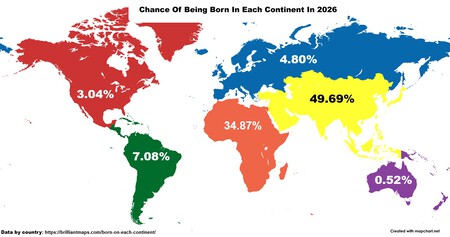
The Global Birth Rate Distribution in 2026
The latest insights from Brilliant Maps reveal intriguing data about birth rates worldwide, focusing on the chances of a baby being born in each continent in 2026. Based on information from Our World in Data, it’s evident that Asia and Africa are the main hubs for global births, collectively accounting for over 80% of all expected births.
The Geography of Global Birth Rates
In total, around 132 million babies are projected to be born in 2026. Nearly half (49.7%) will be born in Asia, while Africa follows with a substantial 34.9%. Together, these two regions represent an astonishing 111.7 million births, leaving just 15.4% of the global total for the remaining continents. In contrast, Europe, with only 6.3 million births, accounts for a mere 4.8% of the world’s total. This stark decline from previous figures points to a significant demographic shift.
Top Countries by Birth Rate
India is expected to lead the world with 23.2 million births in 2026, far ahead of China (8.9 million) and Nigeria (7.5 million). Together, these three countries alone will comprise nearly 30% of global births. The demographic trends in China are particularly striking, having dropped from 16 million births annually in previous years due to a demographic crisis.
Other major contributors in the top ten include Pakistan, Indonesia, the Democratic Republic of the Congo, Ethiopia, and Bangladesh, with Brazil rounding off the list at 2.6 million births. The United States will see over 3.6 million births, placing it in eighth position globally.
Europe’s Demographic Dilemma
Europe experiences the lowest birth rates among all continents, trailing Oceania and North America in absolute numbers. Notably, Spain is projected to have approximately 336,821 births in 2026, ranking 51st in the world. This positions it behind Italy (384,627) and France (638,891) but ahead of Poland (317,916). Germany and the United Kingdom also feature prominently, with 719,249 and 688,388 births, respectively.
The Unique Case of Nigeria
Nigeria stands out as an African exception in the global birth landscape. Ranked third in worldwide births, it vastly outstrips its economic size. The country’s birth rate, almost double the global average, can be attributed to factors like limited access to women’s education and a developing economy.
Future Projections for Africa
Projections up to 2100 indicate a radical demographic transformation. Africa’s anticipated increase to 48% of global births will eclipse Asia’s drop to approximately 38.17%. In contrast, Europe’s proportion is expected to dwindle to merely 4.49%, solidifying its demographic decline. Essentially, within just 75 years, over half of the world’s babies could originate from Africa.
The Global Population Trend
According to forecasts from The Lancet, the global population is set to peak in the 2060s at around 9.7 billion before declining to 8.8 billion by 2100. This demographic shift can be linked to various factors, including increased wealth, educational accessibility, urbanization, and changes in gender roles.
Experts like economist Claudia Goldin suggest that the disparity in parenting ambitions between men and women plays a crucial role in these changing rates. Until social structures better support cooperative parenting, birth rates are likely to continue their downward trend.