
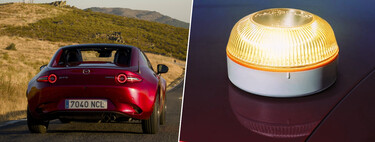
82 days. That’s the timeframe from when the DGT first approved a connected V-16 beacon on December 22, 2022, until March 14, 2023. Just under three months later, Distribuciones Escudero Fijo SL emerged with its own connected device ready for the market.
Based in Valencia, this company was the first to release a DGT-approved V-16 beacon. Interestingly, these beacons are made in China. As a business specializing in the import and distribution of various consumer products, it became clear to them that manufacturing their devices in China was a strategic way to cut costs.
Spanish Approval, Chinese Business
On the Distribuciones Escudero Fijo website, you can find a range of products, from photo printers and Philips car radios to activity bracelets and even a Tesla Smart TV. This showcases the diversity of products they handle alongside the connected V-16 beacon.
The Valencian company isn’t alone in this endeavor. According to the DGT, there are 29 companies with certified approvals to distribute these beacons in Spain, of which only seven are Spanish. This statistic illustrates the overwhelming presence of made in China products, with only about 10% of the 239 registered beacons produced in Spain.
Despite the array of offerings, Distribuciones Escudero Fijo markets up to five connected V-16 beacons, four of which are variants of minor modifications designed to appear as different products. This tactic isn’t uncommon, as several Chinese brands expertly market identical licensed products under various names.
The Case of Limbur Technology
Limbur Technology is a prominent example, producing connected V-16 beacons in China while selling them in Spain with numerous brand variations. Remarkably, they hold 99 active approvals despite showcasing only seven distinct models.
Repetitive Approval Patterns
The process typically involves Ningbo Chakesi Electronics, a Chinese manufacturer, producing these beacons, later marketed under various brands such as Soslight, Orflect, or Don Feliz. Approvals for these devices occur in specialized Idiada laboratories—there are only two authorized laboratories for this task. Instances of identical devices receiving multiple approvals (up to 25 by June 30, 2025) under different branding are quite common.
Manufacturers have limited flexibility in securing approvals, with new features often limited to minor additions, like a new suction cup or improved brightness.
Market Dynamics
Ledel Solutions presents another similar case, boasting 30 active approvals; of these, up to 24 brands sell the identical device. Notably, only one of their marketed products, EmergLight X, shares the same name as the company itself.
The V-16 beacon is ideally suited for mass production, given its low-cost technology, which involves a casing, moderate resistance to dust and water, a battery lasting 30 minutes, and space for a SIM card. This makes it an attractive product for Chinese manufacturers.
Currently, with 239 products registered by the DGT, only around 70 are genuinely distinct offerings. The reality is that most products represent slight variations of a single design, repackaged under multiple brands and sold through various channels.
Photo | DGT and Escudero Fixed Distributions
In Xataka | “Dangerous situations have already occurred”: three road safety experts respond to the imposition of the DGT’s V-16 beacon.