
Global Car Manufacturing Trends in 2024
The automotive industry is witnessing a significant transformation in 2024, with global vehicle sales estimated between 75 to 85 million units, reflecting a growth of over 2% compared to the previous year. This upward tick in numbers raises intriguing questions about market dynamics, particularly which countries are the powerhouses behind this production. The answer is clear: China, dominating the global automotive arena.
Asian Dominance in Vehicle Production
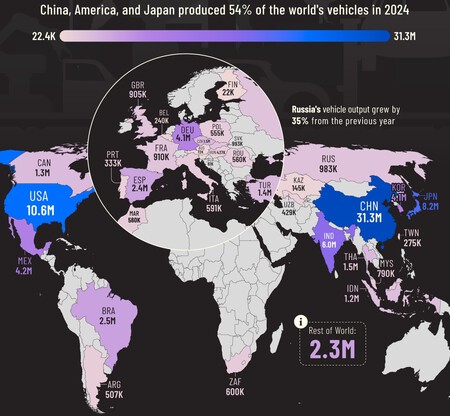
Various reports, like the one prepared by Visual Capitalist using data from the International Organization of Motor Vehicle Manufacturers (OICA), reveal the Asian dominance in vehicle production. In 2024, China produced over 31 million vehicles, representing 54% of the total global production when combined with the figures from the United States (around 10.5 million) and Japan (over 8 million).
However, it’s not just China and Japan that are significant players. India and South Korea are also essential contributors, with production figures standing at 6 million and 4 million respectively. Notably, Japan experienced a 10% decline in production, while Thailand’s figure dropped by an alarming 20%, contributing just 1.4 million vehicles to the global total.
The American Landscape
Turning our gaze across the ocean to the Americas, the United States remains a central figure in the automotive industry despite a 12% decline in production. Contrastingly, Mexico has seen growth, manufacturing 4.2 million vehicles—a 4% increase from the previous year. Brazil also made strides with a 10% increase, producing over 2.5 million vehicles.
This situation positions Mexico as a pivotal manufacturing hub, exporting vehicles not only to meet internal demands but also to various international markets, including the United States. Moreover, Mexico is increasingly becoming a gateway for Chinese automotive brands entering the North American market.
Diverse Vehicle Production Strategies
When evaluating the automotive landscape, it’s vital to highlight the different approaches countries are adopting in terms of vehicle categories. For instance, while China produced 27.5 million cars, the United States focused heavily on commercial vehicles, constructing nearly 9.1 million in that sector compared to just 1.4 million cars.
The table below summarizes vehicle production by country, stating total units produced and the percentage change from the previous year.
| Country | Total Production | % Change |
|---|---|---|
| China | 31,281,592 | 4% |
| USA | 10,562,188 | -12% |
| Japan | 8,234,681 | -9% |
| India | 6,014,691 | 3% |
| Mexico | 4,202,642 | 4% |
| South Korea | 4,127,252 | -3% |
| Germany | 4,069,222 | -1% |
| Brazil | 2,549,595 | 10% |
| Spain | 2,336,504 | -3% |
| Thailand | 1,468,997 | -20% |
European Challenges and Opportunities
In Europe, Germany and Spain continue to play significant roles, with Germany maintaining production levels above 4 million units. Spain, meanwhile, is positioning itself as an attractive site for Chinese manufacturers seeking to establish assembly plants in Europe. Currently, Spain is home to vehicles like the Ebro S800, produced by Chery, showcasing the collaboration between local and international brands.
However, the continent faces challenges, as countries like Italy, Belgium, and Austria have reported substantial production decreases of 32%, 28%, and 37% respectively. These drop-offs can be attributed to trade agreements and market fluctuations significantly shifting consumer demand.
Emerging Markets and Future Considerations
While established powers still dominate, emerging markets are beginning to stir interest. For instance, Russia has ramped up production by 35%, capitalizing on the exit of many Western automakers following geopolitical tensions. Chinese brands are stepping into the void, facilitating local vehicle assembly and contributing to the growth of firms like Lada.
Furthermore, looking towards Africa, countries like Morocco produced 5% more vehicles in 2024, positioning themselves as potential entry points for Chinese manufacturers looking to plant roots in Europe through strategic manufacturing relationships.
The automotive landscape is complex and evolving rapidly. The shifts in production trends highlight the balance between established players like the United States and new contenders such as India and Mexico. The global automotive market’s dynamism calls for continuous monitoring, as adaptability may determine winners and losers in this competitive field.