

The Drone Evolution: How Warfare is Changing in Ukraine
As the conflict in Ukraine continues, it has become evident that drones are not just supplementary tools but rather the backbone of modern offensive strategies. Their utilization has driven both nations to devise countermeasures against drone swarms, showcasing an ongoing arms race in aerial technology. Unexpectedly, Ukraine has found a shield against these threats through the fishing networks of a Danish town, highlighting the adaptability and ingenuity required in warfare. On the opposite side, Russian forces have introduced their latest tactical measure against Ukraine’s drone assaults.
Boom Drones: Turning the Tide of Warfare
The landscape of the Russia-Ukraine war has shifted dramatically, with drones emerging as predominant instruments of warfare. They have evolved from being mere tactical aids to becoming effective executioners, targeting not only armored vehicles but also individual soldiers. Areas like Chasiv Yar and the plains surrounding Kupiansk and Kharkiv are now zones where FPV (First-Person View) drone swarms lie in wait, ready to strike any troop movement.
This new reality has imposed a state of stagnation on the battlefield. Offensive movements are detected and neutralized in a matter of minutes, forcing analysts to reconsider strategies. The core of modern warfare now revolves around whichever side can effectively shield its soldiers from drone threats. Acknowledging this, Russia has unveiled a new portable electronic warfare system designed specifically for their troops, marking a significant shift in anti-drone defense technology.
Design Innovation: Russian Anti-Drone System
A recent video shared on social media unveiled a compact electronic warfare system being utilized by Russian soldiers. This innovation consists of a device affixed to a helmet, featuring two antennas, a connection harness, a mounted screen on the forearm, and a power battery. Although the design appears simplistic, its operational capabilities are anything but.
This system passively detects drone radio signals, intercepting the video feed transmitted to the drone operator. The soldier can then issue commands to interfere with this signal, rendering the pilot blind to the battlefield. What sets this system apart is its focus on disrupting video transmission—an area less protected than standard navigation and control links. This strategic choice minimizes the risk of accidentally jamming Russian communications while preserving the system’s subtlety to avoid detection.
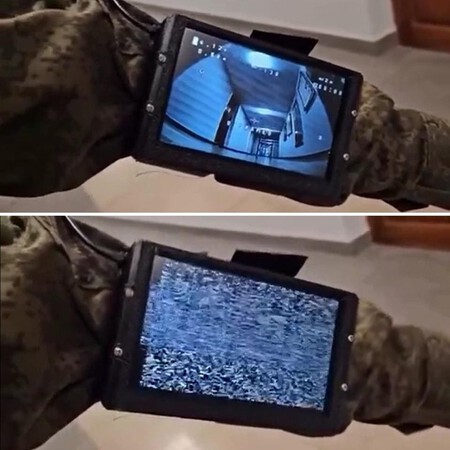
The mounted screen for each soldier enhances tactical capabilities.
Advantages Over Traditional Systems
The Russian electronic warfare system provides notable advantages compared to traditional anti-drone systems . By sidestepping automatic defense protocols often triggered by interrupted navigation, it creates immediate confusion on the battlefield. This approach allows the pilot to lose sight of their target without significant automatic responses from the drone.
Moreover, the portability of this system gives individual soldiers a protective bubble against hostile drones, thereby reducing their reliance on vehicle-mounted systems or fixed bases. This capability is critical in urban or wooded combat zones, where engagements are decentralized.
Challenges and Limitations
Despite its innovative design, the Russian system has its limitations . It proves ineffective against drones transmitting signals through fiber optics , as these transmissions are impervious to radio interference. Additionally, as Ukrainian tactics evolve, they may find ways to mitigate the effectiveness of this system, either through stronger encryption or emergency response protocols that activate when the visual signal is lost.
Potential Strategic Implications
If Russia can implement this technology on a large scale, even with partial success, it could significantly alter the balance of power on critical front lines. Neutralizing drones, even temporarily, allows for offensive maneuvers previously impossible due to constant surveillance from enemy FPVs.
Not being detected for hundreds of meters can pave the way for more aggressive strategies, potentially revitalizing stagnant fronts. This technological arms race reflects a shift from bulkier systems to smaller, individual innovations tailored to the needs of modern soldiers.

The Future of Electronic Warfare
The emergence of portable electronic warfare systems marks a significant evolution in military doctrine, signifying a shift from strategic air platforms to individual soldier-level capabilities. If widely adopted, future combat scenarios will rely heavily on the miniaturization of defenses and their incorporation into standard soldier equipment. If Russia’s new systems prove effective, a new era of warfare may dawn where every combat soldier can wield an “invisible shield” against the ever-dominant drones of the 21st century.