
Recent Discoveries in Medellín Highlight Colombia’s Ongoing Struggle with Historical Truths
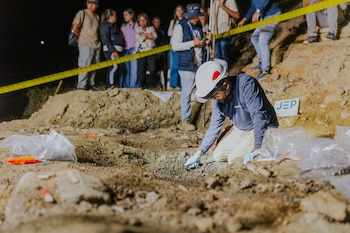
On July 14 and 15, Medellín witnessed a deeply moving event where two bodies were ceremonially delivered to their respective families. This poignant moment was not merely an act of mourning; it symbolized the ongoing struggle for truth and justice in a landscape marred by forced disappearances . Coinciding with this delivery, the Forensic Team of the Special Jurisdiction for Peace (JEP) unearthed additional bone remains—thought to belong to at least two more victims of forced disappearances in a site historically significant in Colombia’s search for missing persons amid its armed conflict.
Located mere meters from where four other victims were discovered between December 2024 and January 2025, this latest discovery reflects the relentless effort being made in this zone, under protective precautionary measures since April 2025. In total, authorities have now exhumed six bodies from this vital enclave of Commune 13 .
Follow us on our WhatsApp Channel and on Facebook
Historically known as a debris landfill on the western slopes of Medellín, the dump has become a focal point for transitional justice efforts. Here, notions of memory , impunity , and hope converge. Authorities categorize this site as part of the provisional fact-finding universe of the Antioquia Subregion , falling under case 08, which investigates crimes linked to public forces in tandem with paramilitary groups, especially during military operations between 2001 and 2004.
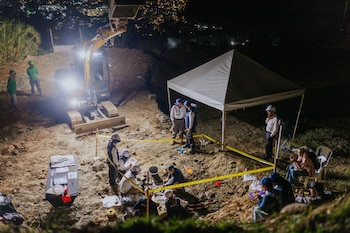
Excavation efforts leading to these discoveries represent a groundbreaking forensic undertaking. Over the past year, the Forensic Technical Support Group (Gatef) of the JEP’s Research and Investigation Unit (UIA) has meticulously removed around 43,000 cubic meters of rubble . This monumental task has been executed with the help of ten forensic experts, twenty operators, specialized machinery, and the technical backing of the Forensic Anthropology Foundation of Guatemala (FAFG). The Mayor’s Office of Medellín also plays a crucial role, providing logistical support.
This site remains one of the most challenging in forensic terms in Colombia. As a result, the JEP has acknowledged the rigorous and extended nature of the investigative work. In tandem, the JEP has privately handed over the remains of two young men discovered earlier in January 2025, victims of forced disappearance dating back to 2002. Preliminary investigations suggest that these individuals were apprehended and subsequently murdered by the Cacique Nutibara block, a paramilitary group that operated in complicity with various elements of the public force. For over two decades, the families of these humble laborers, residents of nearby neighborhoods, have awaited answers regarding their loved ones.
“The deliveries were performed in a private ceremony, where families honored and dignified the memory of their loved ones,” stated the JEP. The transitional justice body reiterated its unwavering commitment to clarifying facts surrounding forced disappearances—one of the gravest and ongoing violations stemming from the armed conflict. The dump, once silent and neglected, is beginning to unveil the truths that Colombia can no longer afford to ignore.
These findings bear significance that stretches beyond forensic implications. They penetrate into the very essence of historical truths and the State’s responsibility towards its citizens. Each body recovered from the dump transcends mere physical evidence; it represents a break in the silence that has long veiled the criminal collusions between illegal armed groups and others. In a society where forced disappearances served as instruments of control and terror, the process of finding and identifying victims becomes a powerful act of resistance against amnesia .
The collaboration between judicial bodies, forensic experts, and local communities highlights the fact that technical approaches must accompany symbolic reparations . In this context, transitional justice seeks not only to assign blame but also to restore fractured relationships between citizens and the State. Thus, the dump transitions from a mountain of rubble and concealed truths into a vibrant symbol of active memory and restored dignity.