
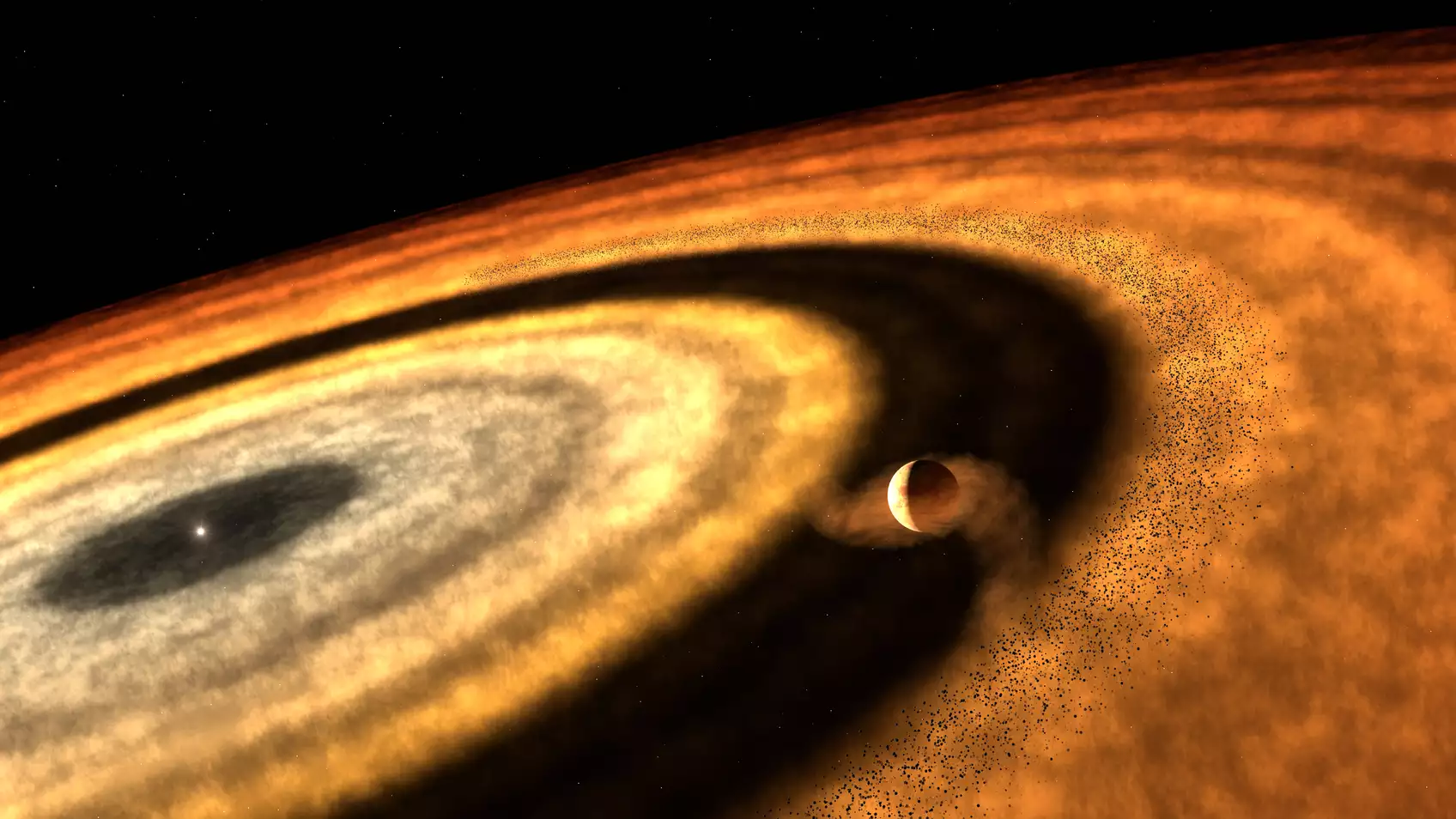

Discover how a molecule never seen in a planetary atmosphere appeared on a scorching world at 3,000°C, revealing unforeseen secrets about exoplanet formation.
This Unprecedented Molecule Found in the Clouds of a Planet 880 Light-Years Away
The James Webb Space Telescope has made a significant breakthrough. For the first time, it detected silicon monoxide (SiO) in the atmosphere of an exoplanet. This molecule, while present in some stars, had never previously been found in a planetary atmosphere. Astronomers have identified it on WASP-121b, a giant exoplanet nicknamed “the hell planet.”
Researchers believe that this SiO originates from silicate-rich asteroids, which the planet’s crushing heat would have disintegrated. On WASP-121b, temperatures can reach a staggering 3,000 °C on the side facing its star. This extreme climate allows silicon monoxide to remain in a gaseous state, which would be impossible under different circumstances.
This Scorching World Defies All Our Knowledge of Planets
WASP-121b is unlike any other known planet. Located approximately 880 light-years away, it is 1.2 times more massive than Jupiter and 1.8 times larger. It orbits its star so closely that it completes a full revolution in just 30.5 hours. This proximity makes it tidally locked, meaning one hemisphere is permanently exposed to sunlight while the other is shrouded in darkness.
In this extreme atmosphere, scientists describe conditions ripe for molten iron rains and violent winds, far surpassing those of Jupiter. Moreover, they observe staggering temperature differences between the two hemispheres. This hellish climate transforms WASP-121b into a perfect laboratory for testing the boundaries of planetary physics.
Chemical Clues Reveal the Chaotic Origin of the Planet
With the instruments onboard the James Webb, researchers have highlighted a variable chemical composition between the planet’s day and night sides. On the dark side, they detected methane, indicating a dynamic atmospheric motion where deep gases rise to the upper atmosphere.
These observations suggest that WASP-121b likely formed farther from its star before dangerously migrating inward. Each molecule detected tells a chapter of this planetary odyssey.
This Technological Achievement Transforming Our View on Distant Worlds
The James Webb Telescope, with its unmatched spectroscopic precision, heralds a new era of exploration. It enables scientists to identify not only SiO but also water, methane, and carbon monoxide. Through these data, they are mapping the chemistry of these extreme worlds.
Moreover, it paves the way for studying smaller, potentially habitable exoplanets. Thus, with each new detection, we add a piece to the puzzle of the universe, while a pressing question lingers: are we truly alone?
General News – 2