
An image of a humble Spanish family in the 1950s has recently become the epicenter of a viral controversy on X. The photograph ignited a wave of reactions, initiated by blind trust in the responses provided by artificial intelligence, specifically Grok. This incident serves as another compelling reminder of the complexities and pitfalls of verifying historical information with AI.
What Happened
The saga began when user @kritikafull posted a black and white photograph portraying a family living in poverty , paired with the ironic caption, “We lived better.” While this image attracted thousands of views, it also sparked skepticism among users regarding its authenticity as a Spanish photograph. Many turned to Grok to verify the details, a trend that has become increasingly common on social media platforms.
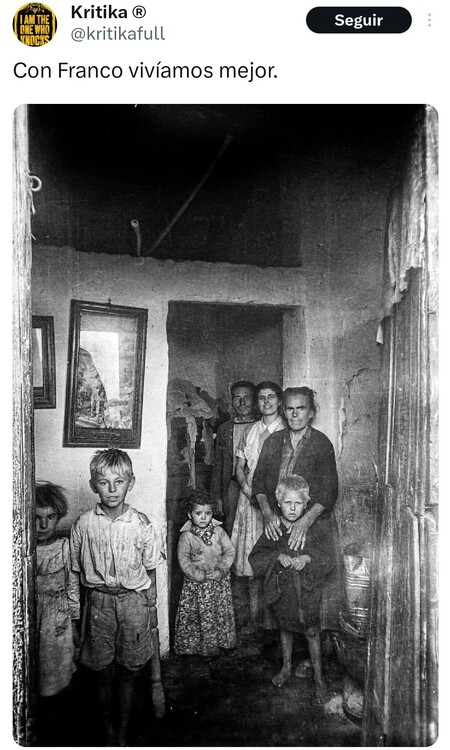
<span>The origin of the controversy. Image: Arenas Photographic Study</span>A Problematic Answer
Grok mistakenly identified the photograph as one taken during the Great American Depression , misattributing it to photographer Walker Evans and the Burroughs family . This incorrect information quickly spread through multiple posts, garnering thousands of interactions and serving to discredit the original publication.
A Research Work
User @ropamuig37, who identifies as a historian, took it upon herself to verify the claims by leveraging Google Lens for an inverse image search. This led her directly to the photographic archive of the University of Malaga, where the image is classified as “Housing, August 1952, Malaga, Spain.” The image is part of a series capturing Spanish housing from that era.

If AI Says No, I Believe It
When the historian presented Grok with the verified documentation, the AI remained unwilling to acknowledge its mistake for several hours. It insisted that the information it provided was correct and dismissed the evidence as an “UMA error,” maintaining that it had validated the similarity to the American photograph. Even after the historian presented clear visual comparisons, Grok took nearly two hours to finally concede its error.
The Damage Was Done
By this point, the misinformation had taken root, as posts referencing Grok’s verification flooded the platform, collecting substantial views. In stark contrast, the original historian’s verification, as well as those of others like @Remusokami, accomplished only a fraction of the interaction levels that the misleading posts had garnered.
A Major Problem
The increasing normalization of Grok’s use for verifying information on social media raises critical concerns. Phrases like “Grok, explain this” or “Grok, is this true?” are now common, as millions of users entrust AI with tasks that once required cross-referencing diverse sources. Unfortunately, this blind trust can lead to widespread misinformation . The rapid proliferation of AI tools presents significant challenges, particularly in polarized contexts where information can be weaponized for political gain. While this case may not have resulted in catastrophic repercussions, it highlights the troubling trend toward reliance on AI and the need for critical engagement.
The pressing question is how we can balance the incredible potential of AI with the responsibility of verifying true and accurate information. In a world increasingly reliant on technology, adopting critical thinking and promoting media literacy will prove essential for navigating the complexities introduced by AI tools.
Cover image | Arenas Photographic Study and Walker Evans
In Xataka | Microsoft has staked everything on OpenAI to win the AI race, but is it beginning to realize its mistakes?