
Adobe’s Unexpected Resilience Amidst AI Threats
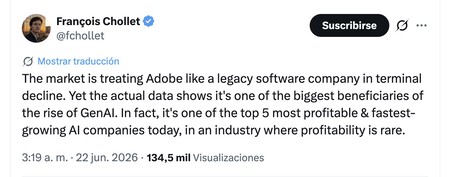
In the past year, Adobe has experienced a significant downturn, losing nearly half of its market value. From a high of $382 twelve months ago, the company now sees its shares trading at around $197. Wall Street has reacted pessimistically, fearing that Adobe could suffer due to the rise of generative AI models. Surprisingly, this fear has proven to be unfounded, as Adobe not only remains stable but actually thrives in the current landscape.
Wall Street vs. Reality
Wall Street says one thing, the data another. During the second fiscal quarter of 2026, Adobe achieved remarkable results, reporting record revenues of $6.62 billion, reflecting a year-over-year increase of 13%. Earnings per share (EPS) soared by 18% to $5.96, contradicting the negative sentiment surrounding its stock. Contrary to market beliefs, Adobe’s position seems to be strengthening, bolstered by its innovative use of AI technologies.
A Money-Making Machine
Adobe is in fact behaving like a true software empire. In 2025, the company recorded a free cash flow of $9.85 billion on revenues of $23.8 billion, showcasing its extraordinary profitability. With operating margins at an impressive 37% (47% on a non-GAAP basis), Adobe’s subscription business continues to shine, boasting an annual recurring revenue (ARR) of $27.1 billion.
Turning AI Into Profit
While others burn money with AI, Adobe earns it. Unlike many companies pouring resources into AI with uncertain payoffs, Adobe has quickly integrated generative AI tools that positively impact its financials. Notably, the ARR dependent on “AI First” solutions has tripled within a year, largely driven by its proprietary generative AI platform, Firefly, which alone has surpassed $250 million in ARR.
Corporate Trust in Adobe
Companies trust Adobe. Though various popular AI tools are available, businesses that depend on Adobe for their creative workflows remain loyal. Currently, 75% of Fortune 500 companies utilize Firefly, while Adobe has trained over 2,500 custom AI models for large corporate clients, solidifying its position in the market.
User Growth and Accessibility
Users do not stop growing. The incorporation of AI has lowered barriers for users unfamiliar with robust software like Photoshop or Premiere. AI assistants enhance user experience by facilitating creation. Tools such as Adobe Express have amassed 70 million active users per month. Moreover, the adoption of a freemium model has driven Adobe’s total user base from 700 million to 850 million in just a year, amplifying its potential for converting free users to paid subscribers.
Facing Strong Competition
But the competition is tight. Despite these successes, Adobe faces a myriad of competitors within a fragmented market. Rivals like Canva have emerged as significant threats, with reported revenues of $4 billion, while platforms like Midjourney and Runway also leverage AI to cater to specific user needs.
Subscription Pricing Concerns
Be careful with subscriptions. Adobe’s journey isn’t without challenges. Recent decisions, such as a notable increase in subscription prices and the limitations on generative credits, have drawn considerable criticism. These moves have prompted some users to explore cheaper or free alternatives like Affinity or DaVinci Resolve.
Uncertainty at the Helm
Uncertainty. One crucial aspect that may shape Adobe’s future is the planned departure of CEO Shantanu Narayen, who has led the company for 18 years. Without a designated successor, the company faces a period of uncertainty. The upcoming leadership transition, particularly in a landscape increasingly populated by generative AI solutions, raises questions about Adobe’s strategic direction moving forward.
In summary, while Adobe has navigated turbulent waters and seen its stock suffer, the underlying data reveals a different story—one of resilience, innovation, and potential growth.